Why deforestation and biodiversity loss matter for the finance sector
Deforestation accounts for nearly 30% of global greenhouse gas emissions and driving catastrophic biodiversity loss – trends that carry significant financial implications. Through their lending and investment decisions, financial institutions can influence global commodity supply chains and can either reinforce high-risk practices or help shift capital toward deforestation-free production.
Forests are essential for planetary health – helping to regulate climate, safeguarding biodiversity, and supporting the livelihoods of over 2 billion people. Yet, global forest loss remains alarmingly high, with a record-breaking estimated 30 million hectares of tree cover lost in 2024, the highest figure since records began. The expansion of agriculture, particularly for commodities like cattle, soya, and palm oil – remains the leading driver.
A new EUDR guide to strengthen financial sector action on deforestation
To support this, ZSL has published a new guide to the EU Deforestation Regulation (EUDR), tailored for relationship managers and the wider financial sector. The guide outlines how relationship managers can proactively engage clients on EUDR-related risks and help them understand it, supporting both their clients and the transition to deforestation-free supply chains.
While financial institutions are not directly obligated under the EUDR, they are exposed to deforestation-related risks across portfolios and play a vital enabling role in helping to tackle the problem. The regulation introduces a new benchmark for supply chain due diligence, and with it, an opportunity for the finance sector to lead on nature-positive transition finance.
What the EUDR guide helps financial institutions achieve
Drawing on ZSL’s expertise and experience of tracking corporate deforestation risks through tools like SPOTT and the Living Planet Index, the guide helps institutions to better understand how to assess exposure, engage and support clients, and demonstrate leadership in sustainable finance.
As the world looks ahead to key climate and biodiversity milestones in 2025, aligning financial flows with deforestation-free production is a crucial step towards a nature-positive future.
Partner with ZSL to strengthen responsible finance
ZSL’s Sustainable Business & Finance programme works with financial institutions to integrate biodiversity, deforestation, and nature risk into decision-making.

Cattle ranching is the biggest driver of deforestation
Sustainability is essential to long-term business success.
Despite this, it is often ignored. Financial institutions on average provide £8.3 billion of financing to companies linked to deforestation – leaving markets, buyers and financers exposed to serious risks.
ZSL is working to change this. Whether it’s advising businesses and investors, or developing innovative new financing models to support local communities, our Sustainable Business and Finance Team work across the globe to empower everyone to build a future where people and wildlife both thrive.
Celebrating 10 years of SPOTT Assessments
Through assessing public disclosure of soft commodity companies, our SPOTT initiative has spent the last decade supporting the financial sector and supply chain stakeholders manage their risks.
Our commodity assessments have expanded from assessing transparency in just 24 palm oil companies in 2014, to assessing 230 companies working across the palm oil, timber and pulp, and natural rubber sectors. We’ve evaluated companies worth over US $400 billion in corporate value collectively, and driven greater transparency across companies around their commitments to environmental, social and governance (ESG) risks.
Each increase in transparency equips our users with the data needed to better understand and manage their risks, supporting more informed and responsible business decisions across their sectors.
Empowering businesses to build a sustainable future
These assessments are some of the most comprehensive due diligence tools available for buyers and stakeholders – but this level of detail also makes them costly to produce. We spend thousands of hours scouring company reports and webpages, collating information and assessing how they compare against up to 192 ESG indicators. This enables our users to make the most informed decisions around risks – but also means each commodity assessment costs up to £100,000 to produce. As part of an international conservation charity, we depend on donations and external funders to drive forward our mission of building a world where people and wildlife thrive together.
We are dedicated to empowering businesses to build a sustainable future for themselves and the planet, and the assessments are just one part of that goal.
We are taking the next year to review how best we can further our mission over the coming years, and that means we are pausing our SPOTT assessments for 2026. The nature of future assessments will depend on funding over the next year.
Protecting your company against the risks of tomorrow
We know the value that our assessments have for our users. We urge buyers and investors that have benefited from our work over the last decade to consider becoming a sponsor, helping us increase transparency and directly drive nature-positive commitments.
The future of businesses and the protection of our natural resources are inherently intertwined – and action to protect our wildlife and the ecosystems we all rely on is needed more than ever.
By investing in these assessments today, you can protect your business against the risks of tomorrow.
The SPOTT website will remain live throughout 2026, and our quarterly newsletter and social channels will continue to provide updates on our wider work across the Sustainable Business and Finance Team. Our team will continue to be available to answer questions about the data.
Help us transform global supply chains to secure a future for all. To join our supporter network or discuss other sponsorship opportunities, contact us at sbf@zsl.org. Direct donations can also be made via donate.zsl.org/spott
Frequently Asked Questions (FAQ)
- Why are we pausing assessments?
SPOTT assessments bring huge value to the financial sector and supply chain holders, and are part of our wider work empowering businesses to build a sustainable future. Each commodity assessment costs up to £100,000 and involves thousands of hours of work, which as a charity is supported by donations and external funders. Pausing the assessments allows us to secure funding and review our next steps to empower everyone in building a future where people and wildlife both thrive.
- When will assessments re-start?
We will spend the coming year reviewing our next steps, which will partly depend on available funding.
- Will the media monitor and substantiated concerns still be updated?
Our routine media searches will be paused over the coming year. If relevant articles come to our attention, we will add these to the media monitor as appropriate.
- Will the SPOTT data remain available?
The SPOTT website will be live until at least the end of 2026, allowing existing data to be accessed.
- Can I still reach out to the SPOTT team with questions about the data?
Yes. We are happy to support users with any questions they may have about company data.
- Can I still join the supporter network?
Yes, to join our supporter network and help us transform global supply chains to secure a future for all, contact us at sbf@zsl.org.
- Will SPOTT communications and newsletters continue?
Yes, the SPOTT newsletter and social media channels will remain active, sharing updates from across the Sustainable Business and Finance Team. Please visit zsl.org/what-we-do/working-with-business/sustainable-business-updates to sign up, and follow us on LinkedIn and X.
- How can I make a donation?
To make a donation and help us support businesses manage environmental, social and governance risks, visit donate.zsl.org/spott
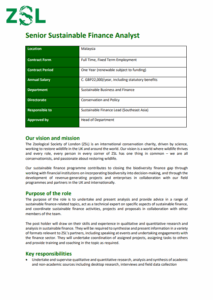
| Position Title |
Senior Sustainable Finance Analyst |
|
Location
|
Malaysia |
| Contract Form |
Full Time, Fixed Term Employment
|
| Contract Period |
One year (renewable subject to funding) |
| Annual Salary |
C. GBP22,000/year, including statutory benefits |
| Department |
Sustainable Business & Finance |
| Directorate |
Conservation & Policy |
| Responsible to |
Sustainable Finance Lead (Southeast Asia) |
| Approved by |
Head of Department |
Our vision and mission
The Zoological Society of London (ZSL) is an international conservation charity, driven by science, working to restore wildlife in the UK and around the world. Our vision is a world where wildlife thrives and every role, every person in every corner of ZSL has one thing in common – we are all conservationists, and passionate about restoring wildlife.
Our sustainable finance programme contributes to closing the biodiversity finance gap through working with financial institutions on incorporating biodiversity into decision-making, and through the development of revenue-generating projects and enterprises in collaboration with our field programmes and partners in the UK and internationally.
Purpose of the role
The purpose of the role is to undertake and present analysis and provide advice in a range of sustainable finance-related topics, act as a technical expert on specific aspects of sustainable finance, and coordinate sustainable finance activities, projects and proposals in collaboration with other members of the team.
The post holder will draw on their skills and experience in qualitative and quantitative research and analysis in sustainable finance. They will be required to synthesise and present information in a variety of formats relevant to ZSL’s partners, including speaking at events and undertaking engagements with the finance sector. They will undertake coordination of assigned projects, assigning tasks to others and provide training and coaching in the topic as required.
Key responsibilities
- Undertake and supervise qualitative and quantitative research, analysis and synthesis of academic and non-academic sources including desktop research, interviews and field data collection
- Preparation and delivery of presentations, reports, project designs, workplans and investment pathways related to sustainable finance
- Relationship development and management with internal and external stakeholders
- Provision of technical advice, support, training and mentoring to clients, partners and internal staff
- Act as technical lead on assigned projects and activities
- Participation in and presentation at working groups, technical committees, workshops and events
- Coordination of project, initiatives and activities, delegation of tasks to others and management of sub-contractors
- Preparation of project proposals and funding applications
The duties and responsibilities described are not a comprehensive list and additional tasks may be assigned from time to time that are in line with the level of the role
Person specification
| Experience |
| Essential |
- Degree in a topic related to sustainability, finance and/or biodiversity or equivalent work experience
- Good experience in research, analysis and presentations on sustainable finance
- Experience working on sustainable finance projects and initiatives, including contributions to innovation in the field
- Experience of working with international teams in cross-cultural environments, including those based in the Global South
- Experiencing coordinating activities and projects, assigning tasks and managing consultants
|
| Desirable |
- Experience manipulating and analysing quantitative datasets
- Experience in market research, business and financial model design
- Experience writing grant applications and project proposals
|
| Knowledge and skills |
| Essential |
- Demonstrated technical expertise in one or more topics in sustainable finance, ESG and investing in nature
- An ability to research, analyse and write reports to a high standard
- Ability to engage with a wide variety of audiences from financial institutions to local organisations in the Global South
- Organisational skills, including the ability to coordinate projects and activities including task delegation
- Strong attention to detail and good record-keeping skills
|
| Desirable |
- Familiarity with R or other data analysis software such as PowerBI
- Familiarity with carbon and biodiversity metrics and standards
- Ability to speak Indonesian/Malay
|
| Additional requirements |
| Essential |
- Have right to work in Malaysia (other locations in Southeast Asia considered)
- Demonstrated passion for nature and biodiversity
- Demonstrated commitment to self-directed learning and professional development
- A willingness to travel internationally
|
Application Process
Submit a CV and cover letter that addresses the key selection criteria to reuben.clements@zsl.org by 12pm BST on Monday, 3 November 2025
SPOTT assesses the most impactful producers, processors and traders in the timber and pulp sector on their public disclosure regarding the organisation, policies and practices related to environmental, social and governance (ESG) issues.
Assessed companies are reviewed on an annual basis to ensure that their inclusion continues to align with this aim and with the needs of our users. The review process includes desktop research as well as consultation with our Technical Advisory Groups. Our selection process takes into account a variety of factors, including the location and extent of the producing and/or processing operations, nominations by interested stakeholders, companies that have volunteered for assessment, evidence of unsustainable practices identified through media reports, and donor expectations.
Nominations welcome
Ahead of this year’s SPOTT assessments we are calling for public nominations of tropical timber and pulp companies. More information on our selection process can be found here.
You can submit company nominations anonymously here.
Or send us an email: spott@zsl.org
The deadline for the submission of company nominations is 31/01/2025.
We would like to invite you to provide feedback to us on the SPOTT Palm Oil indicator framework ahead of the 2024 assessments.
To ensure SPOTT continues to align with best practice reporting standards, we have made two significant changes this year:
- Indicators relating to map data of: company owned estates/management units, scheme smallholders, and third-party supplying plantations must be either georeferenced maps or polygon data for full points. Static maps with coordinates will now score partial points. This affects indicators #20, #21, #22.
- GHG emissions intensity indicators will now apply to traders with physical position of traded product. This affects indicators #101, #102, #105, #106.
We have also edited some indicators either in response to previous feedback, or to align better with our indicator frameworks for Timber and Pulp and Natural Rubber, as well the Aligning Palm Trader Performance Assessment: Aligned question list. Alignment with these questions is shown in column J.
Please download and review the indicator framework and fill in the ‘Reviewer comments’ column (column Q) with any feedback. We welcome feedback on any/all indicators and have highlighted new indicators and indicators with a change to the scoring criteria in column H and our comments in column I.
Please return the attached Indicator Framework document with your feedback by Monday 15 April to imogen.fanning@zsl.org.
Indicator framework – your feedback welcome
We would like to invite you to provide feedback to us on the SPOTT indicator framework ahead of the 2024 assessments.
We have not made any other major changes this year but have edited some indicators either in response to previous feedback, to align with best practice reporting standards or to align better with our indicator frameworks for Palm Oil and Natural Rubber.
Please review the Indicator Framework and fill in the ‘Reviewer comments’ column with any feedback. We welcome feedback on any/all indicators, but have added notes to column Q to highlight the indicators where it would be particularly useful for us to have input. The deadline for feedback is Monday 26th February.
Please return the attached Indicator Framework document by Monday 26th February to samuel.ross@zsl.org
français
Cadre d’indicateurs – vos commentaires sont les bienvenus
Nous vous invitons à nous faire part de vos commentaires sur le cadre d’indicateurs SPOTT avant les évaluations de 2024.
Nous n’avons apporté aucun autre changement majeur cette année, mais avons modifié certains indicateurs soit en réponse aux commentaires précédents, soit pour nous aligner sur les normes de reporting des meilleures pratiques, soit pour mieux nous aligner sur nos cadres d’indicateurs pour l’huile de palme et le caoutchouc naturel.
Des modifications mineures ont été apportées à la formulation des critères de notation pour quelques indicateurs ; cependant, ceci est juste pour fournir des indications supplémentaires sur ce que nous recherchons et ne change pas la nature de la notation. Veuillez consulter le cadre des indicateurs et nous contacter pour tout commentaire. La date limite pour les commentaires est le lundi 26 février.
Veuillez nous retourner le document de la cadre des indicateurs ci-joint avant lundi 26 février pour samuel.ross@zsl.org.