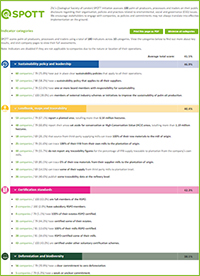
We would like to invite you to provide feedback to us on the SPOTT Natural Rubber indicator framework ahead of the 2023 assessments.
We have edited some indicators either in response to previous feedback, added one new indicator and aligned better with our indicator frameworks for Timber & Pulp and Palm Oil.
Please download and review the indicator framework and fill in the ‘Reviewer comments’ column (column V) with any feedback. We welcome feedback on any/all indicators and have highlighted new indicators and indicators with a change to the scoring criteria in column J.
Please return the attached Indicator Framework document with your feedback by Wednesday 12 October to sam.ginger@zsl.org.
ZSL invites you to submit your proposal for a new M&E Audit consultancy job.
Scope of Work
ZSL (Zoological Society of London) is an international conservation charity working to create a world where wildlife thrives. From investigating the health threats facing animals to helping people and wildlife live alongside each other, ZSL is committed to bringing wildlife back from the brink of extinction. Our work is realised through our ground-breaking science, our field conservation around the world and engaging millions of people through our two zoos, ZSL London Zoo and ZSL Whipsnade Zoo.
ZSL is currently receiving funding from The UK Government’s Forest Governance Markets and Climate (FGMC) programme. The project aims to drive transparent, legal and sustainable forestry practices through financial, market and governance incentives. The tropical forestry sector has the potential to positively contribute to economic and social development and reduce poverty through improved stewardship of forest resources, and associated protection of biodiversity and ecosystem services. The primary tool used to facilitate this engagement has been ZSL’s SPOTT initiative, through engaging key producers and traders of tropical timber and their influencers in the finance sector, civil society, and government, while encouraging the adoption of appropriate policies on legal and sustainable forest management and trade.
SPOTT is a free online platform supporting sustainable commodity production and trade. By tracking transparency, SPOTT incentivises the implementation of corporate best practice. SPOTT assesses commodity producers, processors and traders on their public disclosure regarding environmental, social and governance (ESG) issues. SPOTT scores tropical forestry, palm oil and natural rubber companies annually against over 100 sector-specific indicators to benchmark their progress over time. Investors, buyers and other key influencers can use SPOTT assessments to inform stakeholder engagement, manage ESG risk, and increase transparency across multiple industries.
Project interventions are being evaluated against the impact, outcome and output indicators set out in the project logframe. The Results Framework provides means of verification for progress and provides targets against a given baseline (where possible) throughout the project. The project’s monitoring and evaluation (M&E) framework has been designed to support effective implementation and measure progress toward the project outcome, using the Results Framework to support adaptive management and ensuring lessons learnt from past activities are integrated into ongoing project delivery. This rigorous M&E is crucial to ensure the project achieves its aim, satisfies internal and external scrutiny regarding ZSL’s impacts and demonstrates value for money to funders.
The grant period comes to an end on 31st December 2022. ZSL is looking for a consultant to evaluate the impact of the project to support conclusions drawn in the final report and provide recommendations for improving the M&E system for use in future grants.
Tasks
- Evaluate the project’s Theory of Change (diagram and narrative) and Logframe to determine if the project design is well-structured to deliver the intended impact
- Review the current M&E system against the project Logframe, including the M&E procedures and impact metrics recorded to evaluate if the M&E system is robust
- Sample results from ZSL SPOTT M&E reporting and review evidence of results from project team
- Identify gaps and provide recommendations for improvement of M&E system for use in future grant rounds
- Provide an overview of project impact as well as attribution challenges
Required skills, experience and knowledge
ZSL are inviting proposals from individuals or organizations with the following:
- Extensive, demonstrable monitoring and evaluation (M&E) knowledge and expertise, with experience of the NGO sector
- Demonstrable ability to design, plan, organise, and implement projects and tasks
- Excellent verbal and written communications skills, in English
- Experience of the forestry sector would be an advantage, but not essential
- Submission guidelines and requirements
The candidates must submit the following:
- A technical proposal that is not more than 3 pages
- Examples of previous relevant work
- Proposals must be received by 18th September 2022 to be considered
- Proposals should be submitted to annabelle.dodson@zsl.org for consideration
- ZSL reserves the right to amend the scope of this RFP in order to get the most suitable consultant
RFP & project timeline
| Task |
Timeline |
| RfP announced |
1st September 2022 |
| Proposal submission |
18th September 2022 |
| Discussion with shortlisted candidates re. proposals |
19th – 23rd September 2022 |
| Contract awarded |
30th September 2022 |
| Work to commence |
1st November 2022 |
| Project completion |
1st December 2022 |
Budget
The consultant fee is outlined below:
Gross (£) (Incl. VAT, if applicable) £5,000
NOTE: Consultants are expected to pay all applicable local taxes. Where applicable, these should be included in the cost proposal provided to ZSL.
Download the Scope of Work and Application Instructions Here:
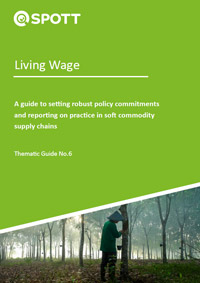
A guide to setting robust policy commitments and reporting on practice in soft commodity supply chains.
This guide is designed to help companies set and report on robust living wage commitments. It is relevant whether you are a producer, processor, trader or buyer of products in soft commodity sectors.
A living wage is “the remuneration received for a standard workweek by a worker in a particular place sufficient to afford a decent standard of living for the worker and her or his family. Elements of a decent standard of living include food, water, housing, education, health care, transportation, clothing, and other essential needs including provision for unexpected events.” (Global Living Wage Coalition).
SPOTT assesses soft commodity companies on their public disclosure of living wage policies.
This Thematic Guide from ZSL provides an overview of the importance of taking the living wage into consideration during policy-making. Other Thematic guides in the series include:
Thematic Guide No. 1 to Zero Deforestation
Thematic Guide No. 2 to Traceability
Thematic Guide No. 3 to Supplier Engagement
Thematic Guide No. 4 to Free, Prior & Informed Consent (FPIC)
Thematic Guide No. 5 to Gender
Les experts du projet SPOTT de ZSL ont mis en évidence dans leurs dernières recherches l’importance pour les entreprises d’adopter une politique solide en faveur de la biodiversité.
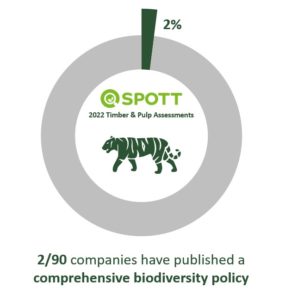
Une nouvelle évaluation menée par l’ONG internationale de conservation de la nature ZSL révèle que seules 2 entreprises parmi les 90 principaux producteurs de bois et de pâte à papier opérant dans les zones tropicales ont mis en place une politique complète pour la biodiversité.
Alors que des records de température sont enregistrés dans le monde entier, ZSL appelle le secteur forestier tropical à fixer de toute urgence des objectifs solides et mesurables pour la réduction de son impact sur le changement climatique ; ce dernier exerçant une pression énorme sur les écosystèmes et la biodiversité dans les régions du monde où les entreprises forestières opèrent.
Les 100 entreprises évaluées sur la plateforme SPOTT de ZSL sont classées en fonction de critères mesurant leur durabilité. Elles gèrent à elles toutes plus de 44 millions d’hectares de forêts tropicales, qui sont les écosystèmes terrestres les plus riches en biodiversité. Ces entreprises et celles qu’elles fournissent exercent donc une influence considérable sur l’état futur de ces zones naturelles. Pour obtenir un bon score sur SPOTT, elles doivent montrer qu’elles ont adopté de solides engagements en matière de durabilité et communiquer sur la manière dont elles mettent en œuvre ces engagements.
Pour la cinquième année consécutive, SPOTT a publié ces évaluations. Elles comprennent un indicateur lié à la biodiversité qui donne des points aux entreprises qui ont adopté et publié une politique claire, avec des objectifs mesurables, de réduction de leur impact sur la faune, la flore, les habitats, et les ressources naturelles. Seules deux entreprises, Intelholco AG et le groupe April, ont obtenu ces points parce qu’elles ont en place des politiques complètes pour la biodiversité, qui incluent des objectifs mesurables de restauration des habitats, de couverture arborée, et de protection des populations locales d’animaux.
L’équipe SPOTT rappelle que ces politiques nécessitent un suivi et des vérifications sur le terrain pour s’assurer qu’elles sont effectivement mises en œuvre. Elles constituent toutefois une première étape essentielle vers l’atteinte des objectifs mondiaux qui seront fixés lors de la COP15 de la Convention sur la Diversité Biologique (CDB) en décembre prochain à Montréal.
Oliver Cupit, chargé du programme « Sustainable Business & Finance » de ZSL, affirme que « la biodiversité disparait à un rythme jamais égalé depuis la dernière extinction de masse. La science est claire : nous n’avons que très peu de temps pour changer les choses. Si les grandes entreprises telles que les producteurs de bois et de pâte à papier que nous avons évalués améliorent leur pratique en faveur de la nature, cela aura un impact significatif. »
« À l’approche d’une année importante pour la nature, avec la COP15 de la CDB et la COP27 de la CCNUCC, nous appelons les entreprises à prendre au sérieux le sujet de la biodiversité. Nos évaluations SPOTT montrent que l’industrie du bois et de la pâte à papier pourrait faire la différence en fixant des objectifs mesurables et alignés sur ceux qui seront adoptés lors de la prochaine COP à Montréal. »
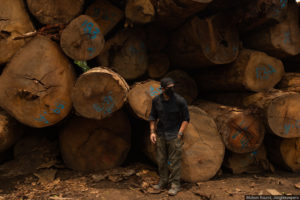
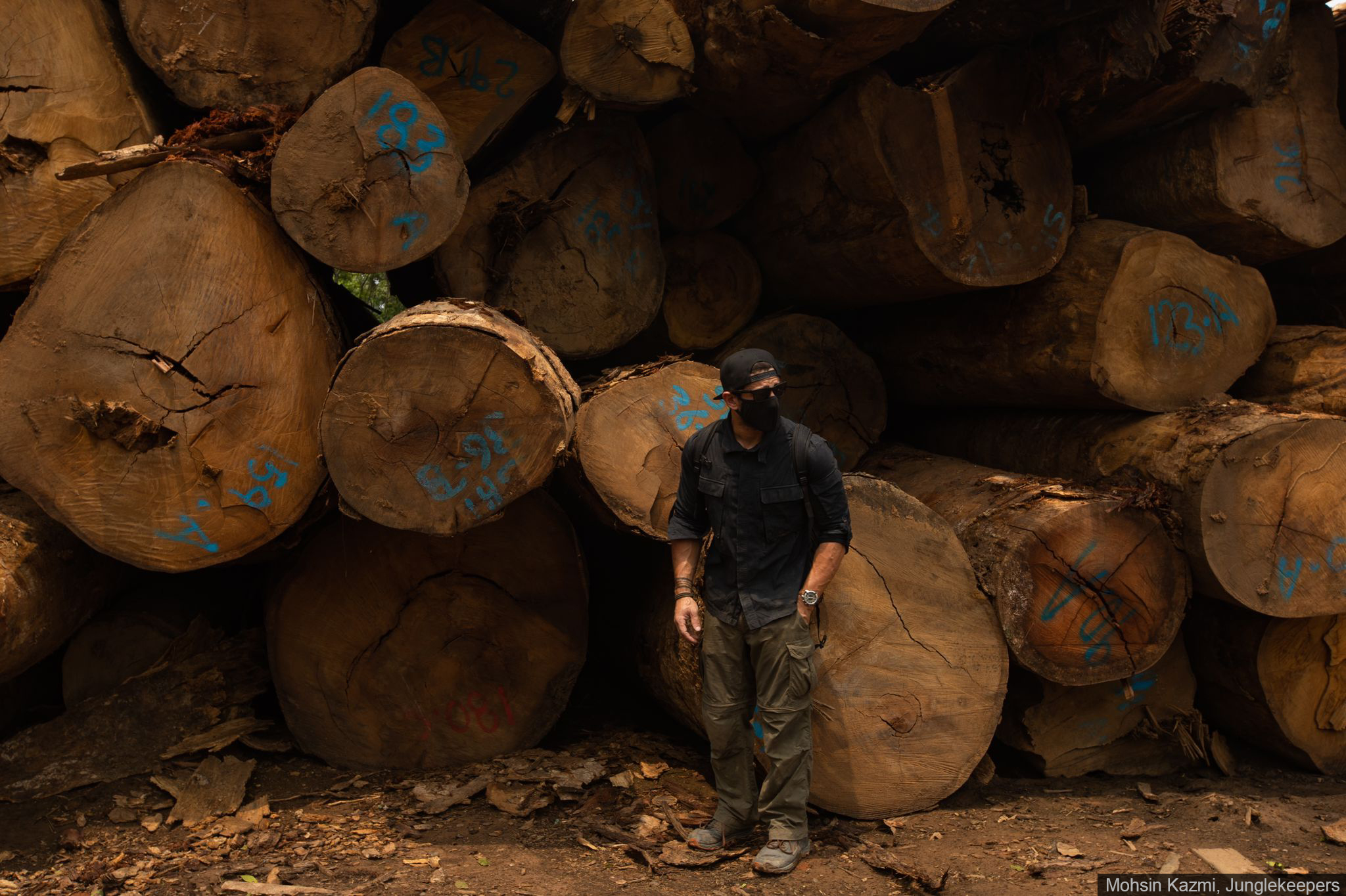
700-1000-year-old ironwood trees logged in the Amazon | Credit: Mohsin Kazmi, Junglekeepers
Les évaluations SPOTT de cette année montrent que seules 48 entreprises sur 90, soit un peu plus de la moitié (53%), ont un engagement « zéro déforestation », et seules 12 entreprises sur 94, soit 13% s’engagent également à s’assurer que tous leurs fournisseurs respectent ce même engagement zéro déforestation.
Seules 8 entreprises sur 90, soit 9%, publient des informations détaillées sur la manière dont elles surveillent la déforestation ou leurs impacts sur les écosystèmes, et seules 10 sur 94, soit 11%, publient des données sur les progrès accomplis pour attendre leur engagement à réduire leurs émissions de gaz à effet de serre. Le changement climatique est l’une des principales causes du déclin de la biodiversité, avec la surexploitation et la disparition des habitats naturels. Parallèlement, la destruction des écosystèmes compromet la capacité de la nature à réguler les émissions de gaz à effet de serre, accélérant ainsi le changement climatique.
« Nous avons le choix » a déclaré la semaine dernière le Secrétaire Général des Nations Unies, António Guterres, dans un message vidéo : « action collective ou suicide collectif : c’est entre nos mains. »
La conférence des Nations Unies sur la biodiversité (COP15) devrait adopter une feuille de route spécifiant la manière dont les dirigeants et décideurs mondiaux vont orchestrer l’arrêt du déclin de la biodiversité d’ici à 2050. Les parties de la Convention s’y réuniront pour conclure les négociations en cours et décider d’un nouveau cadre mondial pour la biodiversité post-2020. Une première version de ce cadre comporte déjà 20 objectifs pour 2030 et reconnaît le rôle du secteur privé dans l’atteinte de ces objectifs.
Oliver Cupit indique que « la plupart des entreprises évaluées améliorent leur transparence et leur durabilité d’année en année, mais l’amélioration générale du secteur est encore décevante. Les entreprises doivent avancer beaucoup plus rapidement sur leurs engagements en matière de durabilité. »
Les entreprises évaluées par SPOTT publient volontairement leurs politiques et autres références en matière de durabilité. Elles travaillent généralement en amont de la chaîne d’approvisionnement : ce sont pour la plupart des entreprises de gestion forestière, mais SPOTT évalue également des entreprises de transformation du bois (scieries) et des grands négociants de matières premières forestières.
Oliver Cupit ajoute qu’un « règlement européen sera bientôt en vigueur pour obliger les entreprises de l’Union Européenne à s’assurer que les produits qu’elles achètent ne sont pas issus de la déforestation dans le pays de récolte. Seule la moitié des entreprises que nous avons évaluées ont un engagement zéro déforestation et 9% indiquent publiquement la manière dont elles surveillent la déforestation. Si le secteur forestier ne met pas en place cette surveillance, il y a un risque que les importateurs européens se mettent à éviter les bois tropicaux en raison de ce règlement. En revanche, les acheteurs européens peuvent utiliser SPOTT dans le cadre de leur diligence raisonnable pour identifier les acteurs les plus proactifs en matière de déforestation et de biodiversité. »
Les acheteurs, institutions financières, ONG et tous les acteurs de la chaîne d’approvisionnement sont encouragés à utiliser les données gratuites et complètes de SPOTT qui sont accessibles à l’adresse www.spott.org.L’ONG internationale de conservation de la nature ZSL appelle les dirigeants du monde entier à placer la nature au cœur de toutes leurs décisions et à faire les efforts nécessaires en faveur de la biodiversité et de la lutte contre l’urgence climatique. Vous pouvez soutenir le travail de recherche et de conservation de ZSL, en savoir plus sur notre travail et faire un don à l’adresse : www.zsl.org.
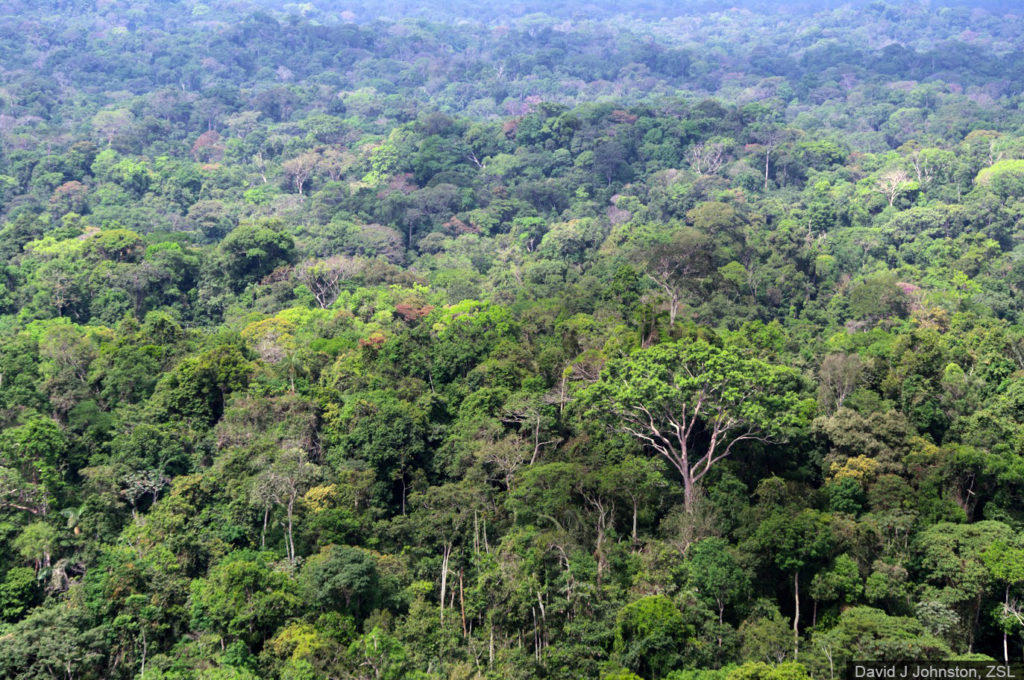
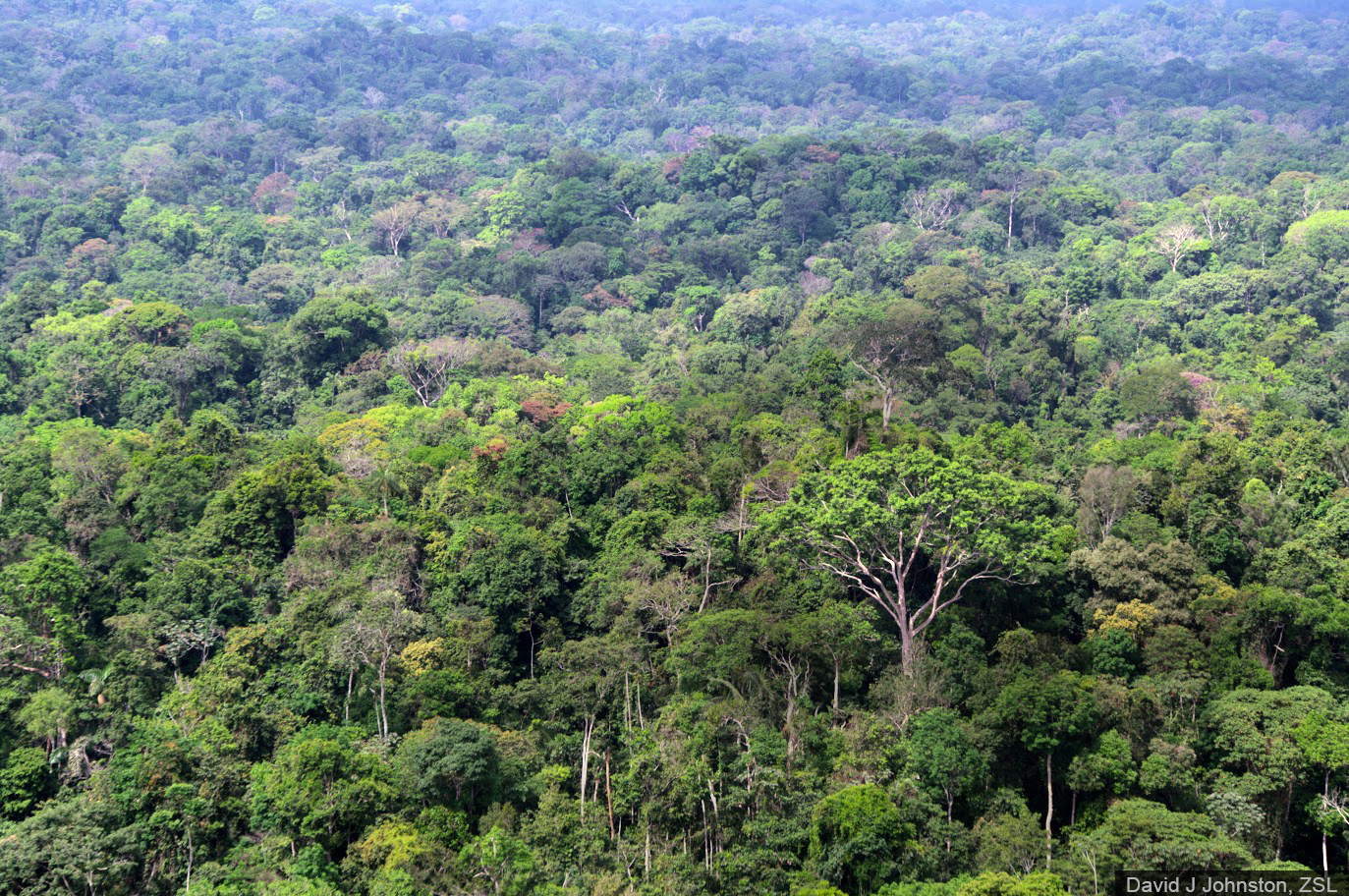
Primary Amazon rainforest landscape in Peru | Credit: David J Johnston, ZSL
A new assessment led by ZSL has revealed that only 2% (2/90) of the world’s leading tropical timber and pulp producers have a comprehensive biodiversity policy.
As record high temperatures are surpassed across the world, ZSL is urgently calling for the tropical forestry sector to set robust, measurable targets to reduce its impact on climate change – which is putting huge pressure on the ecosystems and wildlife where the sector operates.
Ranked according to specific sustainability metrics, the 100 companies assessed on ZSL’s SPOTT platform manage at least 44 million hectares of tropical forests – the planet’s most terrestrially biodiverse ecosystems. These companies and their buyers have a huge influence on the future health of these landscapes. To achieve a top score, they must demonstrate strong corporate sustainability commitments and report on how they are implementing these.
The 2022 assessment – the fifth annual scorecard published on SPOTT – includes a biodiversity indicator, with businesses needing to demonstrate a clear and measurable policy for reducing their impact on wildlife, habitats and natural resources. Only two companies scored full points here, by having comprehensive biodiversity policies in place. These were Interholco AG and APRIL Group who showed evidence of policies which include measurable targets for tree coverage, habitat restoration and protection of local wildlife populations. (See their biodiversity policies here: Interholco AG | APRIL Group)
However, the SPOTT team cautions that the implementation of these policies on the ground requires monitoring and verification to ensure they are effective. Robust policies like these provide a critical first step for companies towards meeting global sustainability targets – due to be set at CBD (Convention on Biological Diversity) COP15 in Montreal this December.
ZSL Sustainable Business & Finance Programme Manager, Oliver Cupit said: “Biodiversity is being lost at a rate not seen since the last mass extinction. The science is clear – we have a very small window of opportunity to change this, but if big companies such as the timber and pulp producers we’ve evaluated make pro-nature changes, we will see a significant impact.
“With a landmark year coming up for nature with the CBD COP15 and UNFCC COP27 on the horizon, we are calling on the corporate sector to take biodiversity loss seriously. Our SPOTT assessments show that the timber and pulp industry could make a huge difference by creating measurable targets that align with the global targets set at the upcoming conference in Montreal this December.”
The annually produced SPOTT scorecard found that while just over half – 53% (48/90) – of companies have a commitment to zero deforestation, only 13% (12/94) of companies also committed to ensuring that all their suppliers adhere to the same zero deforestation standards as them.
700-1000-year-old ironwood trees logged in the Amazon | Credit: Mohsin Kazmi, Junglekeepers
Just 9% (8/90) of companies provided comprehensive evidence of monitoring deforestation or impacts on ecosystems, and only 11% (10/94) of companies reported progress towards commitment to reduce GHG emissions intensity. Alongside over exploitation and habitat loss, climate change is one of the main drivers of biodiversity loss, while destruction of ecosystems undermines nature’s ability to regulate greenhouse gas (GHG) emissions, thus accelerating climate change.
“We have a choice.” said the United Nations secretary general António Guterres last week in a video message on climate change. “Collective action or collective suicide. It is in our hands.”
A roadmap for how global leaders and decision makers will support the halting of biodiversity loss by 2050 is set to be created at the international UN Biodiversity Conference, COP15. Parties to the CBD will gather there to conclude ongoing negotiations and decide on a new Post-2020 Global Biodiversity Framework. The first draft of this already has 20 action-oriented targets for 2030 and recognises the importance of the private sector in achieving these.
Cupit continued: “Most businesses assessed did demonstrate some improvements in transparency and sustainability year-on-year, but the overall improvement for the sector was disappointing and companies must be moving much more quickly on their sustainability commitments.”
The companies assessed on SPOTT – who voluntarily publish their policies and sustainability credentials – generally work at the upstream end of the supply chain with most being forest management companies, but they also include major sawmilling companies and large traders of raw materials.
Cupit added: “The EU regulation on deforestation-free products will soon be in place, requiring EU companies to ensure the products they buy have not led to deforestation in the country of harvest. Only half of the companies we assessed have a public commitment to zero-deforestation and just 9% show evidence of monitoring deforestation. If the forestry sector does not implement comprehensive monitoring, tropical timber could soon be seen as a no-go by EU importers due to this regulation. However, EU buyers can use SPOTT as part of their due diligence to identify which actors are proactively addressing deforestation and biodiversity loss.”
Buyers, financial institutions, NGOs and all supply chain stakeholders are encouraged to utilise SPOTT’s free and comprehensive data which is accessed via the dashboard.
International conservation charity ZSL is calling for world leaders to put nature at the heart of all global decision making and to tackle the loss of biodiversity hand-in-hand with efforts to address the climate emergency. You can support ZSL global science and conservation work by visiting www.zsl.org to learn more about and donate to our work.
Primary Amazon rainforest landscape in Peru | Credit: David J Johnston, ZSL
ZSL, as a sub-grantee alongside Global Canopy, will be launching a revolutionary platform in 2022 bringing together the best data available on corporate exposure to, and reporting on, deforestation and other related environmental, social and governance (ESG) issues.
The project aims to provide market-leading data to help financial institutions identify risks and find opportunities for sustainable investments to meet the growing demand for responsible financial products in light of the biodiversity and climate crises.
The database will be underpinned by the data collected through ZSL’s SPOTT assessments, Global Canopy’s Forest 500 assessments and the Stockholm Environment Institute, Global Canopy and Neural Alpha’s Trase Supply Chains and Trase Finance data, and will be aligned with the Accountability Framework Initiative and its guidance.
Supported by a five-year grant from the Norwegian government, the resulting data and metrics will provide a more comprehensive view of company performance on deforestation, conversion and associated human rights risks. The dataset will also provide broader coverage of the most exposed forest risk supply chains (in particular: palm oil, soy, timber, pulp, rubber and cattle products) and geographies where corporate performance data on these topics is currently missing. By mapping and integrating data from aligned initiatives and external datasets, more complete and in-depth coverage of corporate performance data will be available.
Financial institutions can play a vital role in addressing deforestation and will be at the forefront of the development of this database. Through participation in a Working Group they will help shape the development of this database, ensuring it is relevant, practicable, readily accessible and able to be integrated into existing platforms and processes. Working Group members include Allianz, AXA, Blackrock, BNP Paribas, Credit Suisse, Fama Investimentos, Federated Hermes, HSBC, Lombard Odier, Santander and Storebrand.
Improved transparency on the exposure of individual companies across key supply chains will give financial institutions the information they need to move towards ensuring their investment portfolios are deforestation-free.
If you would like to learn more about this project and how to get involved please contact spott@zsl.org.
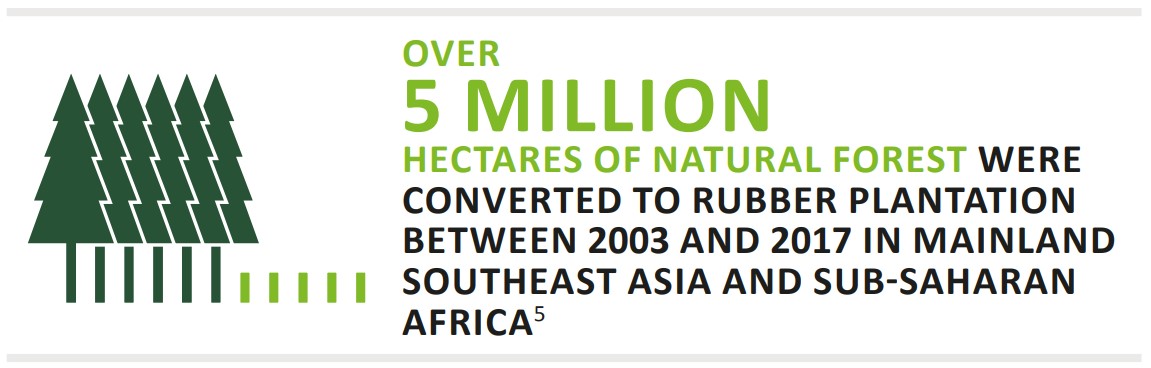
It’s estimated that over 5 million hectares of natural forest were converted to rubber plantations between 2003 and 2017 in mainland Southeast Asia and Sub-Saharan Africa. Renewed ambition to tackle deforestation as a major driver of climate emissions was set out at the UNFCCC climate conference (COP26). Later this year the Convention on Biological Diversity (CBD) COP15 will seek to stimulate similar momentum for biodiversity conservation. The US, UK and EU all have proposed demand-side legislation pending which will seek to eliminate deforestation-linked commodities from their markets. This month, the Global Platform for Sustainable Natural Rubber (GPSNR) helped push forwards voluntary commitments in the natural rubber sector at its 2022 General Assembly.
ZSL has been a member of GPSNR since 2019. Several members of the SPOTT team sit on various working groups and are active members of the Civil Society Organisations (CSO) Caucus. GPSNR was developed by industry but is now a truly multistakeholder platform, including representation not only from CSOs including ZSL, WWF, MightyEarth, Proforest, HCVN, HCSA, Rainforest Alliance, FSC and the Basel Institute for Governance, but also from producers, processors, traders, tyre makers, car manufacturers and, vitally, 135 smallholders or groups from 10 countries. Today GPSNR members represent more than 55% of natural rubber global demand. So, the opportunity is clear – change commitments of GPSNR members and you change sustainability of the rubber sector.
That’s why we participate in this scheme. Sometimes progress can seem glacial and fairly fundamental environmental, social and governance (ESG) assurances can be hard-won. However, in recent years we’ve seen members adopt various requirements which are ratcheting ESG requirements on members and helping bring more transparency. These include:
- GPSNR Policy Framework – which ensures that all members align their corporate sustainability policies with a set of core GSPNR commitments, and to which continued membership is linked.
- GPNSR Reporting Requirements – which set standardised requirements for data to be submitted to GPSNR to demonstrate that member policy commitments are being put into practice.
- GPSNR Grievance Mechanism – a mechanism to provide for amicable redress and remedy of grievances to improve relations between parties where concerns are raised.
- Smallholder inclusion and capacity building – various projects aimed at rolling out Good Agricultural Practices and expanding GPSNR’s reach to the mass of smallholder producers.
The past year has been particularly challenging as we’ve continued to work remotely due to the pandemic. Despite best efforts from all members, working group sessions are simply much more productive when we can sit across the table from one another and share experiences. For one thing it helps us carve out more dedicated time to work through issues. In May this year, GPSNR working group members did manage to meet in Singapore for an intensive week of in-person working group session and this really saw the pace accelerate.
The result of this was some fundamental changes to how the natural rubber sector will operate in the future. We were heartened to see key motions passed at the 4th GPSNR General Assembly this month, including key motions on:
- Transparency requirements for members – requiring publication of a large amount of data on natural rubber supply chains and sustainability performance submitted by members for their reporting requirements. Although we only secured agreement for year 1, a commitment to increased transparency over years 2 and 3 will see more data become available. This move will position the rubber sector as one of the most transparent soft-commodity sectors and shine a light on how corporate commitments are being implemented and monitored.
- Shared Responsibility – a motion allowing the build out of a model for knowledge and financial resources to be shared equitably in the supply chain and targeted to where they can have maximum impact. In simple terms, this motion will push forward proposals for GPSNR members to pay into a natural rubber trust fund based on the volume of global rubber supply they consume, which can then be distributed to smallholder producers at the farm level to tackle deforestation and other environmental and social risks. This model is ground-breaking and sees GPSNR push beyond traditional collective efforts of sustainability schemes.
So, whilst progress can sometimes seem slow in multistakeholder initiatives, it’s worth remembering that large scale structural shifts towards sustainability can be made. GPSNR has much more to do to ensure robust sustainability requirements over the coming years. Here are a few of ZSL’s priorities that we’ll be pushing for as part of GPSNR:
- Develop risk assessment tools for members to use as part of supply chain due diligence and reduce cost of members duplicating efforts. There is a benefit to members being able to select their own service providers for deforestation monitoring and capacity building with smallholders, but certain key datasets such as indicative landscape level High Conservation Value maps would help all members to save cost and act more quickly to address risk in supply chains. What we want to see is members investing in risk mitigation to prevent environmental and social harms, so GPSNR plays a key role in supporting members on risk assessment tools to enable members to focus resources on tackling issues rather than simply identifying them.
- Develop a functional assurance model that will bring together existing requirements on policy commitments and ESG reporting requirements with new components to allow for improved traceability, landscape level due diligence and monitoring and verification of ESG claims. The assurance model will further ratchet requirements and move companies beyond having clear policy commitments and ESG reporting, but will interrogate the integrity of those claims, ensuring that all members are monitoring deforestation, providing capacity building to smallholders, implementing free, prior and informed consent with local communities, reducing carbon emissions, improving water use and protecting soils.
- Ensure greater representation from three key stakeholder groups;
-
- CSOs focussed on Indigenous Peoples and Local Communities (IPLC) rights, to ensure that GPSNR’s ambitions for protecting IPLCs are implemented in the most robust manner possible in the CSO caucus and working groups which help decide GPSNR standards.
- Smallholder groups, to ensure the growth of best practice within smallholder sectors all around the world. It’s estimated that 6 million smallholders produce more than 85% of global natural rubber production. So GPSNR’s goal should always be to expand its reach in this community.
- Financial institutions who fund the natural rubber sector. From our research we know key US financial institutions like Vanguard Group, Blackrock and Dimensional Fund Advisors as well as Japanese Nomura Group, Mitsubishi UFJ Financial Group, Nikko Asset Management all have exposure to the natural rubber sector and should be joining GPSNR to push existing members for higher ambition as well as requiring non-members to join.
- Communicate impact by building a clear monitoring and evaluation framework that will allow aggregation of ESG data generated under the assurance model, as well as supplementing this with additional data where necessary, to allow GPSNR to clearly demonstrate whether its action has resulted in reduced deforestation, improved livelihoods for local communities and increased security for Indigenous peoples and local communities.
GPNSR is certainly still in its infancy and despite members aligning around a clear Theory of Change, there is a continued need to ensure members are pulling in the same direction. There is a need to accelerate the pace of change and ensure that GPNSR does not become a greenwashing exercise but has strict compliance requirements for members. However, the momentum and shared ambition is there across the membership categories. And with this momentum ZSL will continue to participate as an active member of GPSNR, to drive the sector towards standards that we feel will protect biodiversity and ensure a world where wildlife thrives.
ZSL (Zoological Society of London) welcomes the proposal from the European Union (EU) Commission for a regulation on deforestation-free products designed to tackle deforestation associated with products placed on the EU market. However, we call on the EU to include natural rubber in the scope of this regulation, to prevent further deforestation driven by the global tyre industry.
The EU plays a key role in the global rubber supply chain, with a quarter of global natural rubber production going to the European common market. The expansion of rubber plantations has been identified by the European Commission and academia as a significant source of deforestation and forest degradation. It is estimated that over five million hectares of tropical forest was cleared across mainland Southeast Asia and sub-Saharan Africa for rubber plantations between 2003 and 2017.
Oliver Cupit, ZSL’s Sustainable Business & Finance Manager, said; “We believe that the EU deforestation regulation should, from the outset, apply to all commodities with a significant footprint on global deforestation and forest degradation, including natural rubber. This will create a level playing field across commodity sectors and ensure the EU plan doesn’t allow loopholes which lead to continued deforestation.”
The proposed EU deforestation regulation will, as it stands, be applicable to coffee, cocoa, palm oil, soya, beef and wood. After initially being included in the scope of the proposed law, natural rubber was removed by the European Commission (EC). However, this week the EU Parliament’s Environment, Public Health and Food Safety Committee countered this move by calling for the scope of the proposed regulation to be increased to include natural rubber amongst other commodities. ZSL supports this move. We also support the committee’s call for (1) companies to be required to verify that goods in scope are produced in accordance with human rights and the rights of Indigenous people protected under international law and in the country of harvest and, (2) for financial institutions to be subject to requirements to ensure that their activities do not contribute to deforestation.
The EU approach to excluding natural rubber would put it at odds with other legislative initiatives aiming to stop deforestation in the USA and UK, which (at the time of writing) intend to include natural rubber within their scope. It would fly in the face of evidence on deforestation caused by the natural rubber sector and it would signal that current private-sector focus on deforestation through voluntary schemes such as the Global Platform for Sustainable Natural Rubber (GPSNR) is not a priority.
ZSL believes that the regulation will benefit natural rubber supply chains by creating a level playing field amongst companies importing into the EU market – notably through harmonised information requirements – and by driving the demand for sustainably sourced raw materials.
Oliver continued: “We saw a lot of concern around transparency and the impacts on trade, ahead of the EU Timber Regulation being brought into force in 2013. However, these concerns quickly dissipated once the due diligence requirement became the same for everyone and illegal sourcing was targeted. I think these concerns are understandable from the natural rubber sector, but I firmly believe that many actors are already implementing robust due diligence, and this regulation will increase innovation in areas that have historically proven to be tricky for the rubber sector to solve, including corporate transparency, traceability mechanisms and landscape level efforts.
ZSL supports the current proposal for a risk-based approach to due diligence, in order to focus resources where risks are highest in supply chains and supply bases. However, we share the concerns of others regarding proposed requirements for ‘geo-localisation coordinates, latitude and longitude of all plots of land’ where rubber is produced and call for further guidance and engagement with the rubber sector to explore options for a sector where 85% of production is derived from 6 million smallholders. Investment in landscape-level initiatives is one potential option to negate the need for traceability to plot level in all cases.
Bilateral treaties and trade agreements should also be considered in addition to the proposed due diligence legislation to address the underlying drivers of illegal and unsustainable activities, such as corruption and bribery. Progress has been made in the timber sector on these issues under the EU’s Voluntary Partnership Agreements (VPAs) and instead of stepping away from this approach as the EU is currently planning, it should expand the approach to cover all commodity sectors driving deforestation, and seek ways to more broadly tackle corruption in partner countries.
The legislation text will next be negotiated between representatives of the European Council, Commission and Parliament in a “Trialogue” due to take place in Autumn 2022, before being finalised and adopted before the end of the year.
ZSL recommendations
- Include natural rubber in the scope of the EU deforestation regulation: The expected regulation must apply equally to a range of products derived from forest and ecosystem-risk commodities. This should include natural rubber from the outset.
- Include supply-side support as well as demand-side regulation: The EU should implement a robust mechanism to support producer countries to tackle deforestation at source. This should include support to reform and revise national legislative frameworks, focus on tackling corruption and bribery, traceability, assurance and licensing systems, as well as capacity building to the trade sector and especially support to smallholder farmers.
- Address human rights protected under international law and the rights of Indigenous people as part of the proposed EU deforestation regulation.
- Ensure a risk-based approach is applied and expected: To ensure that the level of due diligence expected of commercial operators is proportionate to the scale of risk in their supply chains and sourcing areas.
- Take into consideration the specifics of the natural rubber sector: By due diligence expectations being tailored to the specifics of the rubber supply chain, which is smallholder dominated and lacking in transparency. Support to the natural rubber sector may be needed to address traceability mechanisms and use of landscape-level risk assessment tools.
- Provide sufficient deterrents: By allowing fines and custodial sentences that sufficiently dissuade illegal and unsustainable behaviour by non-compliant companies located within the EU.
- Apply due diligence requirements to the financial sector: To effectively tackle deforestation, the EU should require financial institutions to conduct similar levels of due diligence on companies they finance and invest in.
SPOTT assesses the most impactful producers, processors and traders in the palm oil sector on their public disclosure regarding the organisation, policies and practices related to environmental, social and governance (ESG) issues.
Assessed companies are reviewed on an annual basis to ensure that their inclusion continues to align with this aim and with the needs of our users. The review process includes desktop research as well as consultation with our Technical Advisory Groups. Our selection process takes into account a variety of factors, including the location and extent of the producing and/or processing operations, nominations by interested stakeholders, companies that have volunteered for assessment, evidence of unsustainable practices identified through media reports, and donor expectations.
One company to be removed from SPOTT in 2022
IJM Plantations Bhd will be removed from the SPOTT assessments this year, as it was acquired by SPOTT-assessed Kuala Lumpur Kepong Bhd in 2021. IJM Plantations Bhd’s reporting will now be included in Kuala Lumpur Kepong Bhd’s assessment. All previous assessments of these companies will remain accessible through the SPOTT website.
One company to be included on SPOTT in 2022
The removal of one company from the palm oil assessments in 2022 allows for the inclusion of one new company. In line with our company selection process, we have identified Dhanistha Surya Nusantara as an important company based on consultation with key stakeholders, as well as research of media stories and deforestation rates. ZSL has notified the selected company regarding their forthcoming assessment on SPOTT.
SPOTT assessments of palm oil companies will begin in June, and we will contact companies with their draft assessments in August/September, providing them with the opportunity to make further disclosures ahead of the final review and publication of assessments. Final assessments will be published on SPOTT in November 2022, ahead of the Roundtable on Sustainable Palm Oil (RSPO) Annual Roundtable on Sustainable Palm Oil (RT2022).
Consultancy Position: Spatial Data Analyst (HCVs in Indonesia)
ZSL’s Sustainable Business and Finance programme is seeking a consultant to support on landscape High Conservation Value (HCV) probability mapping and analysis using spatial data. Using ZSL’s existing methodology, the consultant will develop an HCV 1-4 probability mapping for one province in Indonesia, as well as incorporating SPOTT assessment findings into the dataset which can be used for sourcing risk analyses. The consultant will also support ZSL on spatial data analysis for up to three case studies on forest-risk commodity sourcing risk analysis across four provinces in Indonesia.
ZSL’s Sustainable Business and Finance team and SPOTT
The Zoological Society of London (ZSL), a charity founded in 1826, is a world-renowned centre of excellence for conservation science and applied conservation. ZSL’s purpose is to inspire, inform and empower people to stop wild animals from going extinct. This is realised by carrying out field conservation and research in over 50 countries across the globe and through education and awareness-raising at our two zoos, ZSL London Zoo and ZSL Whipsnade Zoo, inspiring people to take conservation action.
The ZSL Sustainable Business and Finance (SBF) programme sits within ZSL’s Conservation and Policy department, and its objective is for business and financial sector practices to be enablers for protecting biodiversity and habitats. A flagship project of SBF is SPOTT – Sustainability Policy Transparency Toolkit – a free, online platform supporting sustainable commodity production and trade. SPOTT assesses commodity producers, processors and traders on their public disclosure regarding their organisation, policies and practices related to environmental, social and governance (ESG) issues. Investors, buyers and other key influencers can use SPOTT assessments to inform stakeholder engagement, manage ESG risk, and increase transparency across the palm oil, natural rubber and tropical forestry sectors.
ZSL’s HCV probability mapping
In 2020, the Sustainable Business and Finance team, in collaboration with our colleagues in the ZSL Indonesia office, began mapping potential landscape-level High Conservation Values (HCVs) in key provinces in Indonesia. This began with South Sumatra and Jambi – two provinces where we have had a focus for many years – and we have now completed a mapping for Riau as well. We have also been combining this mapping with our data from the SPOTT assessments. We have mapped the location of mills belonging to SPOTT-assessed palm oil companies across each province using Global Forest Watch’s Universal Mill List data, and for each one have analysed the total area of potential HCV identified within a 50km sourcing radius of that mill. We are then able to cross-reference this with information from our SPOTT assessments – such as traceability progress, commitments and reporting on HCV identification and management, and procedures for assessing mill risk and engaging with suppliers.
The Consultant will support us to develop this work further, by repeating the mapping and analysis for an additional province in Indonesia, determined by ZSL (likely to be North Sumatra, but to be confirmed). This will include analysis of existing spatial datasets, development of a further forest cover data layer, and mapping HCVs at landscape level for the province. The consultant will follow ZSL’s existing methodology, which is based on the HCV Network’s guidance documents. This process, including gathering required datasets, will be led by the consultant but supported by the SBF team located in the UK.
The consultant will also provide support to the ZSL team in spatial data analysis as part of up to three case studies ZSL is creating, on analysing potential risk to HCVs from companies producing or sourcing palm oil (and/or other forest-risk commodities) in this newly mapped province as well as Riau, Jambi and South Sumatra. This support is likely to take the format of a more detailed spatial analysis of threats to HCVs around a particular mill or concession site, e.g. by integrating satellite imagery to identify deforestation rates.
ZSL is seeking a consultant with knowledge of HCVs, forest-risk commodity supply chains in Indonesia, and experience creating and analysing spatial datasets.
Deliverables
- Landscape-level HCV probability mapping for one province in Indonesia (likely North Sumatra, but to be confirmed). This will follow ZSL’s existing methodology but with improvements/additions made where needed. Findings and any changes to methodology to be summarised and provided to ZSL in an accessible format (e.g. Word document or Powerpoint presentation).
- Sourcing risk analysis using SPOTT data, for the same province. ZSL will provide all SPOTT data and instructions on methodology.
- Three case studies of forest-risk commodity sourcing analysis within the same province, and/or Riau, South Sumatra, and Jambi. This will include looking at landscape-level HCVs and company sourcing risk using SPOTT data, as well as satellite data on forest loss.
- All relevant data, including data layers, shapefiles and map images, will be provided to ZSL.
Requirements
All requirements below are mandatory unless stated as desirable.
- Strong spatial data analysis skills, including proficiency in use of GIS programmes (e.g. ArcGIS, Q-GIS, etc)
- Remote sensing expertise; at least 5 years experience working with optical satellite monitoring datasets. Experience using radar and lidar is also desirable.
- Knowledge and applied experience of High Conservation Value (HCV) screening/mapping
- Knowledge of Indonesian forest-risk commodity sectors (specifically palm oil, forestry and/or natural rubber sectors).
- Excellent communicator, able to distil and summarise complex information in an understandable way
- Fluency in English
- Fluency/competency in Bahasa Indonesia (desirable)
- Strong contact network with relevant stakeholders in Indonesian soft-commodity sector and local/national government (desirable)
Submission requirements
Applicant shall submit:
- A short (<5 page) proposal, outlining their suitability for the contract, strategy and workplan, timelines and any other considerations.
- CVs of all staff who will/may work on the contract.
- Budget clearly showing the number of days allocated to the contract, as well as day rates applied to all staff. Plus, any expenses expected to be included.
For more information or to ask questions regarding this ToR, please contact Eleanor Spencer (Sustainable Business Specialist, Asia) at eleanor.spencer@zsl.org
Submission deadline
Submission of final proposals should be sent to Eleanor Spencer (Sustainable Business Specialist, Asia) at eleanor.spencer@zsl.org by 9am (UK) Monday 13th June 2022.