Image credit: Toby Smith/CCI
Non-governmental organisations (NGOs) can play a vital role in ensuring that sustainability standards are informed by best practice and continual improvement. NGOs also play a key role in their development and implementation, contributing specialist sector knowledge, bringing perspectives on multi-stakeholder initiatives being rooted in principles of deliberative democracy and granting legitimacy in place of governments. However, there are many barriers to engagement in standards, particularly from environmental and development NGOs.
There are over 400 sustainability standards in current use or development, and engagement requires significant investment of resources. Some standards are therefore not as strong as they could be from environmental, social and governance (ESG) perspectives. At best this represents a missed opportunity for NGOs to maximise benefits from a key stage of industry development. At worst it risks allowing below-par standards to define business as usual for the foreseeable future.
The Zoological Society of London (ZSL) is collaborating with the Cambridge Conservation Initiative (CCI) on an exciting project to strengthen sustainability certification. This pilot project will seek to build and test a platform to support and enable NGOs to engage more effectively with standard development, implementation, and monitoring. It aims to ensure that standard setting bodies are continuously improving the level of rigour and performance required to be certified leading to better managed and more sustainable operations.
Check back soon for updated information on this project. This work is being supported through CCI’s Collaborative Fund for Conservation, which is funded by Arcadia, a charitable fund of Lisbet Rausing and Peter Baldwin.
Samir Whitaker | 13 Aug 2018 | London, UK.
Plus tôt ce mois-ci, le gouvernement français a soumis son projet de stratégie nationale de lutte contre la déforestation importée (SNDI) a consultation du public. Le document reconnait notamment que le secteur financier peut contribuer à la lutte contre la déforestation importée.
Overview
La stratégie 2018-2030 définit la déforestation importée comme ‘L’importation de matières premières ou de produits transformés dont la production a contribué, directement ou indirectement, à la déforestation, à la dégradation des forêts ou à la conversion d’écosystèmes naturels en dehors du territoire national.’ À ce titre, elle prend pour cible les importations agricoles qui contribuent le plus à la déforestation et identifiées comme telles par des études récemment publiées par la Commission Européenne : l’huile de palme, le soja, l’hévéa, la viande de bœuf, le maïs, le cacao et le café. 1
Le rôle du secteur financier
La SNDI reconnait l’importance d’une diligence raisonnable accrue concernant les pratiques d’investissement. La France est déjà reconnue pour son avancement en matière d’investissement responsable, notamment à cause de l’Article 173 de la Loi de Transition Énergétique (qui impose des obligations de rapportage non-financier aux investisseurs).
Sur la même lancée, l’Objectif 6 de la SNDI (Orientation 3) a pour but de réduire la déforestation importée en intégrant de manière explicite les problématiques de déforestation aux stratégies d’investissement et de financement. Le projet de stratégie propose notamment :
- D’élargir les obligations de rapportage des entreprises et des investisseurs
- D’accroitre les financements au bénéfice de pratiques agricoles et forestières durables
- D’encourager les engagements des acteurs français, notamment institutionnels (y compris par le biais de stratégies d’alignement « 2-degrés ») 2
- D’encourager la finance verte et des approches innovantes (obligations vertes, labels pour les produits financiers durables). 3
Plus d’engagement du secteur privé et plus de transparence pour favoriser les prises de décisions
Mis a part les propositions de la SNDI concernant l’intégration d’objectifs « zéro déforestation » dans les plans de filière au niveau national (Objectif 14), le projet de stratégie insiste sur l’importance de la publication d’informations non-financières (Objectif 11).
Faisant suite à l’adoption d’une loi obligeant certaines entreprises à mettre en œuvre des mesures de vigilance raisonnable vis-à-vis des risques environnementaux et sociaux en 2017, la SNDI propose de renforcer la directive 2014/95/UE dite RSE / NFI (qui requiert les grandes entreprises à inclure des informations non-financières dans leurs rapports annuels). Ceci pourrait contribuer à de meilleures pratiques d’investissement dans la mesure où cela permettrait l’accès a davantage d’informations concernant les activités des entreprises.
La demande pour les produits certifiés
Les filières et le secteur financier reposent sur l’approvisionnement responsable et la certification pour évaluer la manière dont leurs clients (et eux-mêmes) progressent vis-à-vis de leurs engagements liés à la déforestation. A ce titre, il est important de s’attarder sur un autre aspect de la stratégie.
La SNDI projette de soutenir l’adoption de politiques d’achats publics « zéro déforestation » (Objectif 12), d’améliorer l’étiquetage environnemental des produits (Objectif 8), et de promouvoir l’adoption de la certification et le renforcement des standards de certification (Objectif 8).
S’agissant du renforcement des standards de certification, le document fait une liste relativement complète des problématiques ESG les plus fréquemment présentes dans les filières à haut risque de déforestation. Ces problématiques sont par ailleurs toutes intégrées dans les critères d’évaluations de SPOTT pour les entreprises du secteur de l’huile de palme et du bois et de la pâte à papier. Cela inclut notamment l’adoption des approches High Conservation Values (HCV) and High Carbon Stock (HCS), l’interdiction de convertir les forêts et les tourbières pour la production agricole, l’application du « Consentement Libre Informe Préalable », du droit du travail et normes de l’Organisation internationale du Travail (OIT) et le soutien aux petits producteurs.
A suivre
La stratégie reconnait le besoin d’équilibre entre questions de développement et protection environnementale, et défend dans ce sens une approche différenciée d’un secteur à un autre et d’un pays producteur à l’autre. Le projet soumis à consultation suggère que la stratégie reposera sur plusieurs définitions plus ou moins strictes de ce qui représente une foret en fonction du contexte (définition de la FAO, définitions nationales et juridiques, définitions dérivées des méthodes HCV/HCS). Bien qu’il soit important de prendre les conditions locales et régionales en considération, il est important de rappeler que seuls les espaces qui correspondront à la (aux) définition(s) choisie(s) seront susceptibles d’être protégés.
Plus crucialement, le document dans sa forme actuelle manque d’objectifs chiffres, ce qui pourrait réduire son impact et compliquer l’évaluation de son efficacité et de sa mise en œuvre.
Pour accéder au projet de stratégie et répondre à la consultation : http://www.consultations-publiques.developpement-durable.gouv.fr/spip.php?page=article&id_article=1849
La consultation sera ouverte jusqu’au 24 juillet 2017.
Banner image credit: Gregoire Dubois on Flickr CC BY-NC-SA 2.0
______
1. Le bois et la pâte à papier sont aussi des imports associes a la deforestation, cependant, en la matiere, la strategie renvoie a d’autres instruments tells que FLEGT et le RBUE (qui est entre en application en Mars 2013) et ont aussi pour role de repondre aux problematiques liees a la deforestation.
2. Notamment par le biais de l’initiative Finance for Tomorrow de la place de Paris.
3. Y compris grace au plan d’action de la Commission européenne « financer la croissance durable ».


The past year has seen some significant developments for SPOTT. SPOTT has expanded to feature assessments of timber and pulp producers against a new indicator framework to highlight best practice in the forestry industry. SPOTT currently assesses 24 timber, pulp and paper companies and will be expanding to assess a total of 50 companies in the coming months.
We revised our indicator framework for assessing palm oil producers to encompass more environmental, social and governance (ESG) issues across 125 indicators covering 10 different categories, such as community, land and labour rights, and governance and grievances. These comprehensive assessments also now assess companies on their operational disclosure relating to sustainability, and two traders have been added.
The 2017 palm oil assessments found that the number of companies scoring well against SPOTT indicators has increased significantly since SPOTT was launched in 2014. While the average score was less than 30% in June 2014, it reached 50.4% in November 2017, with 17 companies scoring over 65%. The first timber, pulp and paper assessments tell a different story, with a lower average score of only 37%. However, we expect to see relatively rapid progress during future assessments as the industry responds to the need for greater transparency.
There is a growing demand for ESG information, highlighted in SPOTT assessments, driven by investors and buyers, as they become more aware and sensitive to the financial, operational, and reputational risks posed by ESG issues in commodity production. ZSL works closely with these stakeholders who use our benchmarked company information to identify where palm oil and timber, pulp and paper companies are performing well and where concerns need addressing. We recently published a guide to the SPOTT indicator framework to help palm oil producers and their investors understand these risks and how they can be addressed. SPOTT was also shortlisted for a Responsible Investor Award in 2017, recognising our contribution to promoting and developing investment best practice.
In the last quarter of 2017, we commissioned an external consultant to conduct a scoping study to inform the expansion of SPOTT within existing, and to additional, commodities (soy, cattle, rubber etc). In addition to examining where opportunities exist, the consultant engaged with stakeholders and key SPOTT users on their views. In addition to the final report’s recommendations, we welcome any feedback to help develop our strategy on the future direction of SPOTT.
With ever-increasing concerns over the risks associated with unsustainable commodity production, ZSL looks forward to developing SPOTT further, to meet the growing demands of stakeholders for transparent ESG reporting, and helping to increase transparency in other industries.
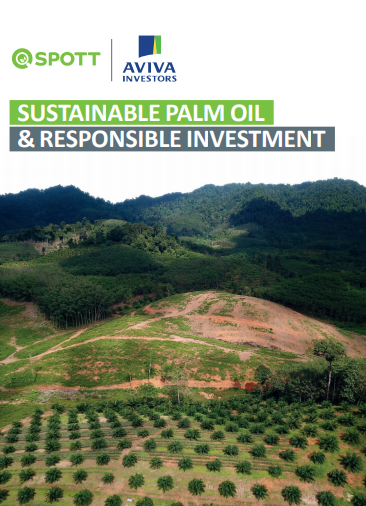
Palm oil investors are being urged to keep sustainability issues high on their agenda through a new report launched by international conservation charity ZSL (Zoological Society of London) in partnership with Aviva Investors.
Years after the first reports emerged linking the palm oil industry with environmental destruction and human rights abuse, the sector is still considered high risk for investors in 2018. Despite these concerns, global demand for palm oil continues to grow, accelerating expansion into regions such as West Africa.
The report from Aviva Investors and ZSL’s dedicated Sustainability Policy Transparency Toolkit (SPOTT) team – Sustainable Palm Oil and Responsible Investment – highlights that investors have the power to transform the whole palm oil industry, by encouraging the companies they finance to adopt more responsible policies on deforestation, land conflicts and labour conditions. Focusing on the palm oil investment case through case studies, it outlines key questions that institutional investors should ask during their engagement with oil palm growers, traders and buyers, to help incentivise improvements to their environmental, social and governance (ESG) practices.
Joyce Lam, Manager for ZSL’s SPOTT team, comments: “Palm oil is not going away anytime soon, and neither are the risks associated with it. The good news is that the push for more transparency and corporate disclosure is no longer the sole concern of environmental and social NGOs. Investors have become more aware of the financial, operational, and ESG risks associated palm oil production. This makes investors a driving force in bringing the laggards up to speed. ZSL is proud to partner with Aviva Investors to publish this guide, which – together with the transparency assessments of palm oil companies that SPOTT provides – is designed here to support these vital conversations.”
The palm oil sector has become infamous for malpractices including companies and smallholder farmers resorting to damaging slash-and-burn practices to clear forest for plantation development. Documented cases of deforestation, land conflicts and forced labour has meant that palm oil producers and buyers have seen their operations disrupted and criticised. Intense public campaigns against these practices has led to increased reputational risk, governmental scrutiny and regulatory pressure. As the negative impacts of palm oil production increasingly impact the reputation of institutional lenders and investors in the palm oil sector, the case for engagement by the finance sector to push for sustainable palm oil production is becoming ever-stronger.
As a result, many businesses and financial institutions have now made commitments and adopted NDPE (‘No Deforestation, No Peat, No Exploitation’) policies, to exclude unsustainable palm oil from their supply chains and investment portfolios. However, implementing such commitments in practice is slow and complex. Even though various companies and financiers have made sustainability commitments to address ESG risks, many are yet to follow, thus potentially creating ‘leakage’ and an uneven playing field across the industry.
Abigail Herron, Global Head of Responsible Investment for Aviva Investors, said: “Investors have the power – and indeed the moral duty – to push for best practice in the palm oil sector. The business case for investment in the palm oil sector cannot ignore environmental and social considerations and, together with ZSL, we are calling for increased engagement with companies to help speed the transition towards a sustainable palm oil industry. We hope this guide promotes greater transparency across the sector and encourages fact-led dialogue to steer current practice in the right direction.”
 This year, the 8th Forest Stewardship Council (FSC) General Assembly 2017 will take place in Vancouver, Canada, from 8-13 October. Taking place every three years, the General Assembly is a critical platform to allow members to discuss the challenges and solutions of responsible forest management, and the role the FSC can play.
The FSC currently certifies a total area of almost 200 million hectares across 84 countries, but only 13% (around 18 million hectares) is tropical and subtropical forest, while only 7% is natural forest, as opposed to plantations. Though the area of certified tropical forests grew by some 50% between 2007 and 2013, there is still a long way to go to protect these critical ecosystems.
With tropical forest areas increasingly under threat, responsible management of remaining tropical forest landscape is essential. FSC certification – through the creation of more sustainable tropical timber and pulp markets – allows businesses and consumers to support tropical countries in ending deforestation.
The General Assembly’s Tropical Forest side event – on Monday 9 October, 4:30-6pm – will focus on the impacts of FSC certification in the tropics, with a case study from Precious Woods, a timber producer with operations in Brazil and Gabon, and an insight into market access for tropical forest smallholders in Mexico.
During this event I will also present an overview of our forthcoming SPOTT assessments of timber and pulp companies operating in critical tropical forest landscapes. SPOTT promotes transparency and accountability to support environmental, social and governance (ESG) best practice.
If you have registered for the FSC General Assembly, please join us on Monday 9 October, 4:30-6pm in Room SPB2, Westin Bayshore Hotel.
The annual conference of the Principles for Responsible Investment (PRI) took place in Berlin from 25-27 September. PRI in Person is a unique opportunity to take stock of the progress in responsible investment practice all over the globe as investors gather to share knowledge on the integration of environmental, social and governance (ESG) factors into investment decisions.
This year saw a focus on climate action and on the role of investors in championing the Sustainable Development Goals through investment decisions. Engagement was another topic of interest during the conference, as an audience poll showed that a majority of investors present believed that engaging with investee companies had the potential to improve corporate performance.
Attendees were given a primer on the results of two studies commissioned by PRI to learn from engagement processes between companies and investors.

The authors of the first study mainly found that investors who had lead successful engagements with companies were likely to increase their shareholding in the years following the engagement. This finding should provide further incentive for companies to respond to engagement to the best of their capacity.
Among other things, the second study explored the benefits of engagement for companies and investors. Investors engage to achieve better financial and ESG performance. Successful engagement on these issues means that investors can deliver value to their clients and demonstrate their commitment to stewardship.
More importantly, companies benefit from engagement in multiple manners. First of all, engagements are an opportunity to understand their investors’ expectations in relation to ESG issues. Companies’ representatives who were interviewed also stated that investors helped them identify new ESG trends and demonstrate their commitments and best practice – in which case investors were seen as a free consultancy service of sorts.
Read the article dedicated to the second study on PRI’s website to find out more.
PRI will publish a full report on the findings of the study entitled ‘How can ESG engagement create value for investors and corporations’ at the end of the year.
As Forestry Officer for the Zoological Society of London (ZSL), my job involves working with timber and pulp companies to improve corporate sustainability and transparency, specifically the disclosure of policies, commitments and information relating to environmental, social and governance (ESG) best practice. Information on ESG issues is particularly important for investors and buyers when making decisions about responsible investment and sourcing.
 It was therefore a privilege to attend the International Union of Forest Research Organizations (IUFRO) 125th Anniversary Congress, from 18-22 September in Freiberg, Germany. As a global network of forest scientists, IUFRO boasts more than 15,000 members in 120 countries, and provides a platform for fostering dialogue and exchange of scientific knowledge.
The IUFRO 125th Anniversary Congress focused on a range of topics including mitigating climate change, conserving biodiversity and creating jobs and income through forest science. During the conference I presented on the expansion of SPOTT to cover 24 timber and pulp companies operating in critical tropical forest landscapes, and highlighted the importance of meeting the ESG requirements of investors and buyers through enhanced disclosure.
Originally developed to assess palm oil producers and traders, SPOTT features detailed frameworks of ESG best practice indicators for palm oil and timber and pulp companies, assessments for which will be published in November 2017.
A recent study commissioned by the Roundtable on Sustainable Palm Oil (RSPO) Biodiversity and High Conservation Value (HCV) Working Group investigated the challenges to effective HCV management and monitoring (M&M) in oil palm plantations.
Effective management and monitoring is important to ensure the protection of HCV areas, because they can contain significant levels of biodiversity, rare species, and/or carry important cultural value for human communities. The report provides recommendations for establishing best management practices (BMPs) for HCV M&M.

HCV forest © Mike Senior/Proforest
The report notes that, while 31 out of 50 palm oil companies assessed on SPOTT have public commitments to undertaking HCV assessments prior to any new planting, only two companies make their M&M plans publicly available for all their estates.
Improved disclosure of M&M plans could improve transparency and accountability, as well as giving investors and downstream companies confidence that companies are implementing their commitments.
The project partners were the HCV Resource Network, Daemeter Consulting, Forest Peoples Programme (FPP), Proforest and the Zoological Society of London (ZSL). Read the full report on the HCV Resource Network.
India’s consumption of palm oil is the highest of any nation in the world, and the country therefore has the potential to play a significant role in driving sustainable practices.
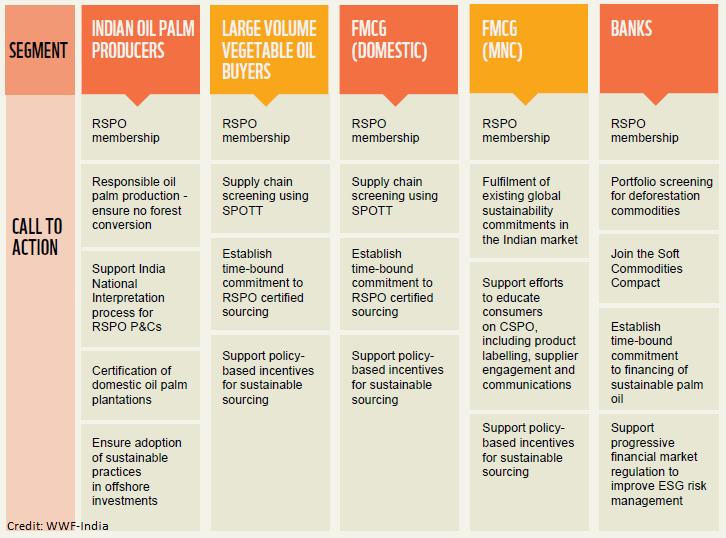
Palm Lines, a new report by WWF-India, highlights the key role that India can play in driving improved sustainability practices in the sector, including through the use of SPOTT for supplier screening.
SPOTT assessments can be integrated into a wider sustainable supply chain strategy, in particular to identify areas of supplier risk and to frame an action plan for supply chain improvement.
Companies can use SPOTT to initiate dialogue with suppliers to understand their areas lacking transparency and rapidly screen for exceptionally poor performers.
By informing potential customers about the sustainability commitments of palm oil producers, SPOTT helps buyers meet their own commitments, supporting and incentivising sustainable production.
The report highlights actions that key industry players – including producers, buyers, consumer goods manufacturers and banks – can take to drive the sustainability agenda in palm oil, summarised in the table below.
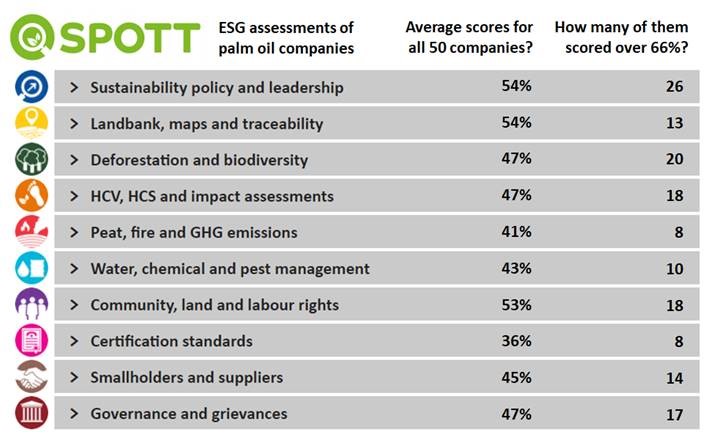
The Zoological Society of London (ZSL) recently published a blog post on the CFA Institute’s Asia-Pacific Research Exchange (ARX), highlighting for the first time the discrepancies between companies’ commitments and their implementation. Commodity producers were scored against a revised framework of 125 environmental, social and governance (ESG) indicators under 10 categories using publicly available corporate commitments and policies.
The results show an average of 13% difference between commitment and implementation scores. Among the top scoring companies (those scoring above 66%) only two have implementation scores that match their commitment scores. The remainder have variations in scores ranging between 13.03% and 30.53%.
The table below summarizes how many companies reach the top tier (>66%) in each category: