

Everyday supermarket products, many containing palm oil or its derivatives
ZSL is pleased to be working with WWF on a new collaboration to support stronger environmental and social performance across the palm oil sector.
Palm oil remains one of the world’s most widely used vegetable oils, embedded in global food, personal care, biofuel and oleochemical supply chains. When produced responsibly, it can support livelihoods and meet global demand efficiently. However, the sector continues to face significant challenges, including deforestation, ecosystem conversion, labour and human rights risks, legality concerns, and the need for stronger traceability.
A central part of the collaboration will be the development of the WWF-ZSL Palm Oil Traders & Refiners Index (POTRI), and we are now inviting feedback on the draft indicator framework, ahead of the first company assessments in 2026. Details on how to take part are below.
About the collaboration
- WWF-ZSL Palm Oil Refiner/Trader Index. A new assessment of some of the largest integrated palm oil refiners and traders, described in full below, and the subject of the consultation now open.
- Practical learning resources for financial institutions. Two e-learning modules for the finance sector that will support stewardship, ESG and relationship-management teams to better understand palm oil supply chains, key environmental and social risks, and what credible progress looks like. A second module will focus on the EU Deforestation Regulation, helping relationship managers understand what clients will need to demonstrate and how to structure engagement and escalation.
- Supply-chain mapping in Indonesia, Malaysia and Papua New Guinea. Using available datasets, supplemented by targeted research, the work will help build a clearer understanding of “who buys from whom” across selected production landscapes.
The WWF-ZSL Palm Oil Traders & Refiners Index (POTRI)
ZSL’s SPOTT platform assesses a broad range of commodity producers, processors and traders across palm oil, timber and pulp, and natural rubber. Building on that, this Index serves as a distinct, complementary assessment, focusing specifically on some of the largest integrated palm oil traders and refiners, and placing increased emphasis on evidence of implementation and progress, not only commitments
These companies play an important role in connecting producers, manufacturers, retailers and financial institutions, and their policies, sourcing practices and supplier engagement can influence sustainability outcomes across large parts of the palm oil supply chain.
Drawing on ZSL’s SPOTT methodology, WWF’s Palm Oil Buyers Scorecard, and the Palm Trader and Refiner Performance Assessment aligned question list, the draft framework has been developed to support more consistent, streamlined engagement with key actors in the palm oil sector.
The assessment will be supported by qualitative risk profiles, bringing together insights from grievance cases, media reporting and other external signals to provide a fuller picture of company performance.
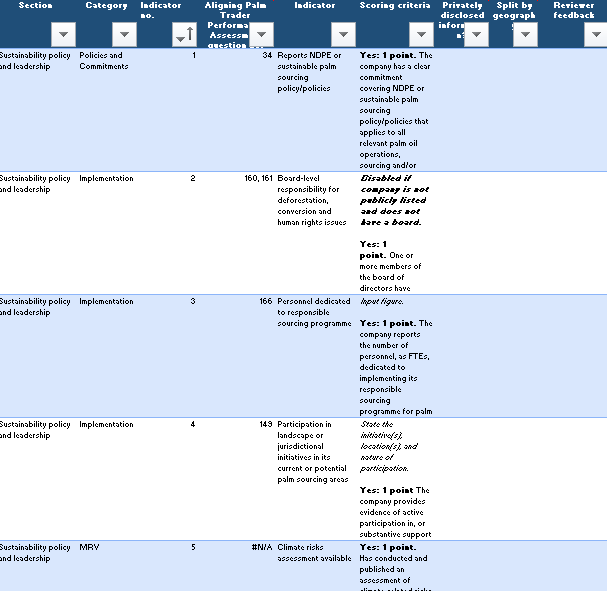
Feedback welcome on the draft indicator framework
WWF and ZSL welcome feedback on whether the draft indicators reflect current best practice, whether the scoring criteria are clear and proportionate, and whether any indicators would benefit from further detail, clarification or refinement.
Feedback is welcome on any part of the framework, including the indicator wording, scoring criteria, guidance notes and alignment with relevant frameworks or standards.
The consultation period opens today and will run until 30 July 2026.
How to submit your feedback
Please download the draft indicator framework and add your comments in the ‘Reviewer comments’ column, Column I.
Please return the completed Indicator Framework document by 30 July 2026 to imogen.fanning@zsl.org.
Provisional assessment timeline
- July 2026 – Assessed companies notified
- July – August 2026 – Analysts review company reporting and prepare draft assessments
- August/September 2026 – Assessed companies invited to review their draft assessments
- November 2026 – Final assessments published on the WWF website ahead of the RSPO RT
By combining ZSL and WWF’s tools and expertise, this work aims to support greater transparency, more practical engagement and stronger accountability across the palm oil sector. It will also help financial institutions, CGMs and Retailers ask better questions of clients and suppliers respectively, understand the evidence needed to assess progress, and use their influence to support more sustainable outcomes.
We look forward to receiving feedback on the draft framework and sharing further updates as the work develops.
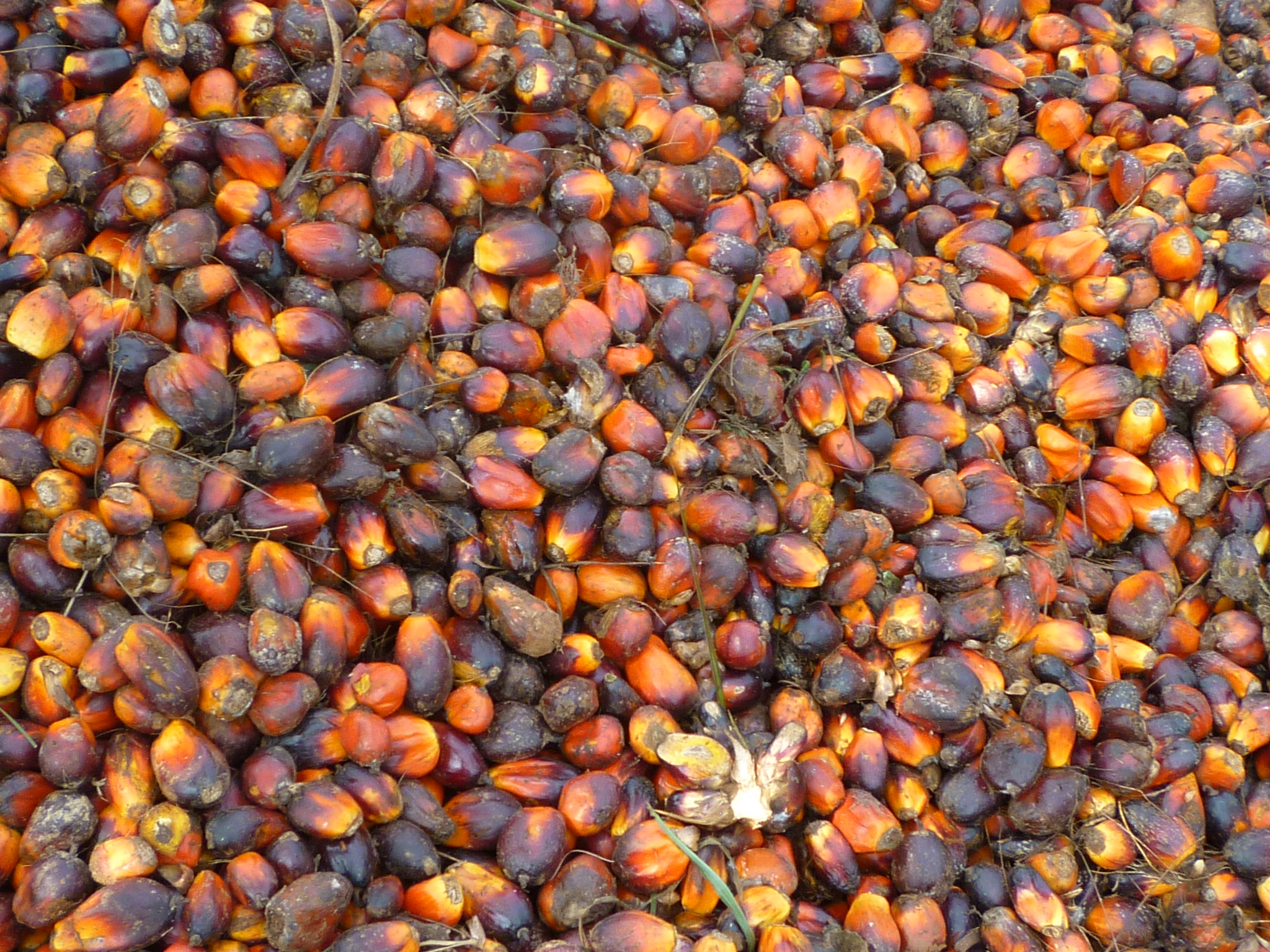 Oil palm fruits by Sophia Gnych