As another hazy dry season looks set to loom across Southeast Asia, the latest SPOTT assessments find palm oil producers and traders varying in their commitments to combating fires and ensuring sustainability. While some companies are making positive progress in disclosing critically important information, many could be far more ambitious in making stronger and wider commitments to manage risks such as deforestation and human rights abuses.
ZSL’s SPOTT initiative conducts assessments for 50 of the world’s largest palm oil producers and traders, including big players such as Astra Agro Lestari, Sime Darby and Wilmar International. SPOTT assesses these companies against a revised framework of 125 indicators using publicly available data on environmental, social and governance (ESG) issues.
Each company receives a total percentage score based on the indicators that apply to their operations, along with scores breaking down performance against the following 10 categories:
Sustainability policy and leadership
1. Sustainable palm oil policy or commitment for all its operations
2. Policy or commitment applies to direct and third-party suppliers
3. High-level position of responsibility for sustainability
4. Sustainability report published within last two years
5. Member of industry schemes or other external initiatives to improve sustainability or transparency
6. Verification report on compliance with Palm Oil Innovation Group (POIG) Charter, if a POIG member
7. Activities with government and/or non-governmental organisations (NGOs) to improve sustainability
Landbank, maps and traceability
8. Total land area managed/controlled for oil palm in hectares (ha)
9. Total oil palm planted area (ha)
10. Plasma/scheme smallholders planted area (ha)
11. Unplanted (areas designated for future planting)(ha)
12. Conservation set-aside area, including High Conservation Value (HCV) area (ha)
13. Area for infrastructure (ha)
14. Number of company owned mills
15. Maps of company owned mills
16. Number and names of supplying mills
17. Maps of estates/management units
18. Maps of scheme/plasma smallholders
19. Time-bound commitment to achieve 100% traceability to mill level
20. Time-bound commitment to achieve 100% traceability to plantation level
21. Percentage of supply traceable to mill level
22. Percentage of fresh fruit bunches (FFB) from own mills traceable to plantation level
23. Percentage of FFB from supplying mills traceable to plantation level
Deforestation and biodiversity
24. Commitment to address deforestation
25. Commitment to zero deforestation
26. Commitment applies to scheme smallholders and independent suppliers
27. Criteria for defining deforestation
28. Evidence of monitoring deforestation
29. Commitment to set aside areas for conservation
30. Evidence of habitat management and/or habitat restoration of set-aside areas
31. A landscape-level approach
32. Commitment to biodiversity conservation within concessions
33. Commitment to not endanger species of conservation concern, referencing international or national system of species classification
34. Commitment to no hunting or only sustainable hunting of species
35. Commitment not to operate within internationally and nationally designated protected areas
36. Evidence of species conservation
HCV, HCS and impact assessments
37. Commitment to High Conservation Value (HCV) approach
38. Commitment to only use licensed HCV assessors accredited by the HCV Resource Network’s Assessor Licensing Scheme (ALS)
39. Commitment applies to scheme smallholders and independent suppliers
40. HCV assessments undertaken between November 2005 and December 2014, and management and monitoring plans
41. HCV assessments for all estates planted since January 2015
42. HCV management and monitoring plans for all estates planted since January 2015
43. Satisfactory review of all HCV assessments undertaken since January 2016 by the HCV ALS Quality Panel
44. Commitment to the High Carbon Stock (HCS) approach
45. HCS assessments
46. Commitment to conduct social and environmental impact assessments (SEIAs)
47. SEIAs undertaken since November 2005, and management and monitoring plans
Peat, fire and GHG emissions
48. Commitment to no planting on peat of any depth
49. Commitment applies to scheme smallholders and independent suppliers
50. Commitment to best management practices for soils and/or peat
51. Landbank or planted area on peat (ha)
52. Evidence of best management practices for soils and/or peat
53. Commitment to zero burning
54. Commitment applies to scheme smallholders and independent suppliers
55. Evidence of management and monitoring fires
56. Details/number of hotspots/fires in company estates
57. Details/number of hotspots/fires within surrounding landscape/smallholders
58. Time-bound commitment to reduce greenhouse gas (GHG) emissions
59. Commitment applies to scheme smallholders and independent suppliers
60. GHG emissions
61. GHG emissions from land use change
62. Methodology used to calculate GHG emissions
63. Progress towards commitment to reduce GHG emissions
64. Percentage of mills with methane capture
Water, chemical and pest management
65. Commitment to manage water use and water quality
66. Time-bound commitments to improve water use and water quality
67. Progress towards commitment on water use
68. Progress towards commitment on water quality
69. Protection of natural waterways through buffer zones
70. Evidence of treating palm oil mill effluent (POME)
71. Commitment to minimise the use of chemicals, including pesticides and chemical fertilisers
72. No use of paraquat
73. No use of World Health Organisation (WHO) Class 1A and 1B pesticides
74. No use of chemicals listed under the Stockholm Convention and Rotterdam Convention
75. Integrated Pest Management (IPM) approach
76. Chemical usage per ha or list of chemicals used
Community, land and labour rights
77. Commitment to human rights, referencing the United Nations (UN) Declaration of Human Rights or UN Guiding Principles on Business and Human Rights
78. Commitment to respect legal and customary land tenure rights
79. Commitment to respect indigenous and local communities’ rights
80. Commitment to free, prior and informed consent (FPIC)
81. Commitment applies to independent suppliers
82. Free, prior and informed consent (FPIC) process
83. Process for addressing land conflicts
84. Commitment to ensure food security for local communities
85. Commitment to respect workers’ rights, including all workers (i.e. direct, indirect, migrant, temporary, casual, etc.)
86. Reference to International Labour Organisation (ILO) Fundamental Conventions or Free and Fair Labour Principles
87. Total number of employees
88. Percentage of temporary employees
89. Percentage of women employees
90. Minimum wage that the company pays
91. Commitment to address occupational health and safety
92. Lost time accident rate
93. Number of fatalities as a result of work-based accidents
94. Provision of personal protective equipment and pesticide training

Certification standards
95. Member of the Roundtable on Sustainable Palm Oil (RSPO)
96. Submitted most recent RSPO Annual Communication of Progress (ACOP)
97. Listed all countries and regions in which it operates in most recent RSPO Annual Communication of Progress (ACOP)
98. Time-bound plan for achieving 100% RSPO certification of estates within five years or achieved 100% RSPO-certification of estates
99. Time-bound plan for achieving 100% RSPO certification of scheme/associated smallholders within five years or achieved 100% RSPO-certification of scheme/associated smallholders
100. Time-bound plan for achieving 100% RSPO certification of all supply chains
101. RSPO-certified within three years of joining the RSPO or by November 2010, for companies joining prior to finalisation of the RSPO certification systems in November 2007
102. Percentage of mills RSPO-certified
103. Percentage of area (ha) RSPO-certified
104. Percentage of FFB supply from scheme/associated smallholders that is RSPO-certified
105. Percentage of FFB supply from independent FFB suppliers that is RSPO-certified
106. Percentage of all palm oil and oil palm products handled/traded/processed that are RSPO-certified
107. Sells or processes/trades RSPO-certified palm oil through Segregated or Identity Preserved supply chains
108. Indonesia Sustainable Palm Oil (ISPO) certified
109. Malaysia Sustainable Palm Oil (MSPO) certified
110. Certified under voluntary sustainability certification scheme (e.g. ISCC, SAN, RSB, etc.)

Smallholders and suppliers
111. Programme to support scheme smallholders
112. Details of support programme for scheme smallholders
113. Number or percentage of scheme smallholders involved in programme
114. Programme to support independent smallholders
115. Details of support programme for independent smallholders
116. Number or percentage of independent smallholders involved in programme
117. Process used to prioritise, assess and/or engage suppliers on compliance with company’s policy and/or legal requirements
118. Suspension or exclusion criteria for suppliers
119. Number or percentage of suppliers assessed and/or engaged
Governance and grievances
120. Commitment to ethical conduct and prohibition of corruption
121. Whistleblowing procedure
122. Own grievance or complaints system
123. Accessible to internal stakeholders (i.e. employees)
124. Accessible to external stakeholders
125. Grievances, if anonymity not requested, including the following details: date, issue, complainant category, actions taken, and status
As Indonesia enters its dry season, the polluting haze that sweeps over the region during this time is often attributed to fires started to clear land. Given estimates over 2.5 million hectares – 100 million tennis courts – of land burned in 2015, it is encouraging to see an increase in corporate “zero burning” policies and evidence of implementation. More widely, however, there is little evidence of companies monitoring and reporting on implementation of “zero deforestation” commitments, potentially placing valuable forests and carbon-rich peatlands at risk.
Companies also scored poorly on new biodiversity indicators, with many producers lacking commitments to protect habitats and endangered species, especially outside of conservation areas. Few companies have published time-bound plans on reducing their greenhouse gas (GHG) emissions, and even fewer have public commitments to manage water responsibly.
In response to user needs and feedback, SPOTT assessments now score companies in more detail on social and governance issues, including policies on the fair treatment of workers, anti-corruption and whistleblowing. In obtaining free, prior and informed consent (FPIC) from local and indigenous communities affected by development, company policies lack detail in describing customary rights and to whom they apply. Not all of the companies have grievance processes in place, and few give details on the steps towards remediation.
ZSL’s palm oil technical advisor, Izabela Delabre, said: “We revised SPOTT’s indicators to provide a more comprehensive and in-depth analysis of corporate progress on addressing ESG issues, and to give more weight to the implementation of commitments. After sending companies their draft assessments last month, we have seen many of them showing eagerness to engage with us, as well as making subsequent disclosures of important sustainability information. We are observing a demonstrable increase in buy-in from top management with regard to ESG issues, and willingness to progress.”
Recently shortlisted for a Responsible Investor award, SPOTT also highlights recent media reports relevant to the assessments, in order to provide evidence of policy implementation and hold the industry to account.
The Zoological Society of London’s (ZSL) SPOTT initiative is expanding to assess the transparency of major forest product producers operating in priority tropical areas, scoring companies on their commitments to environmental, social and governance (ESG) best practice. We have selected 24 companies for publication by November 2017.
Timber and pulp production – a growing problem
International trade in wood products represents a market worth billions of dollars per year. This market requires a huge input of raw materials from the world’s forests, with global demand for industrial roundwood estimated to reach two billion cubic metres per annum by 2030 – an increase of 25% in twenty years.
Growth in production will be underpinned by increased demand for wood products: with consumption of pulp and paper products set to more than double by 2060; and the market for solid wood products anticipated to increase by at least a quarter over the same period. As the supply of wood from developed countries is set to carry on falling as demand grows globally, forest nations in the tropical zone will likely play an ever more important role in production.
If managed appropriately, the world’s forests have the potential to provide these renewable commodities in perpetuity. However, growing global demand is pushing tropical countries to produce cheap timber and pulp through the unsustainable exploitation of primary forests and the development of fast-growing plantations in place of these natural forests. Such activities may jeopardise both the long term economic development of producer nations and the globally important environmental services provided by natural forest ecosystems – including carbon storage, watershed regulation, and biodiversity conservation.
Tools for responsible investment
In the past ten years, the shift towards more sustainable and responsible patterns of investment has been pronounced, with an increasing number of investment professionals making commitments to sustainable finance initiatives such as the UN Principles for Responsible Investment. The delivery of these commitments can be made more difficult by the operational and reputational risks faced by tropical zone forest product producers, particularly as the finance sector increases its exposure in these emerging markets. To mitigate these risks, investors can use the information provided by SPOTT to improve their engagement processes and inform the research which guides their investment decisions.
New ESG indicators and assessments
SPOTT currently assesses the public disclosures and commitments of palm oil producers to provide Environmental, Social and Governance (ESG) relevant information to investors, buyers and other stakeholders looking to fulfil their own commitments. SPOTT assessments for timber and pulp companies will provide users with a tried and tested toolkit for monitoring the transparency of key forest product companies operating in the tropics.
Corporate transparency will be assessed through an indicator framework that draws on established sustainable forest management best practice principles – for example, the identification and appropriate management of High Conservation Value (HCV) areas. By assessing publicly available information against these indicators, the new assessments will help stakeholders to monitor progress, support uptake of best practice and foster better on-the-ground outcomes.
SPOTT will focus on tropical forests given their extremely high species diversity, vital role in livelihoods, and importance as carbon sinks and stores. Forest loss due to fire and forestry is also greatest in the tropics. According to Supply Change, an estimated 53% of timber and 37-60% of pulp exports from tropical countries have displaced forests.
Country selection
To identify priority countries we applied a range of criteria to countries in the tropics such as amount of primary forest cover (FAO 2015), tree cover loss (GFW 2014 and FAO 2015), Industrial Roundwood production (ITTO 2014) and Intact Forest Landscape area (GFW 2014). We also considered the size of timber, pulp and paper industries within each country, and the extent to which they are driving deforestation. Our appraisal of deforestation risk made use of WWF’s Deforestation Fronts driver and threat assessments among other sources.
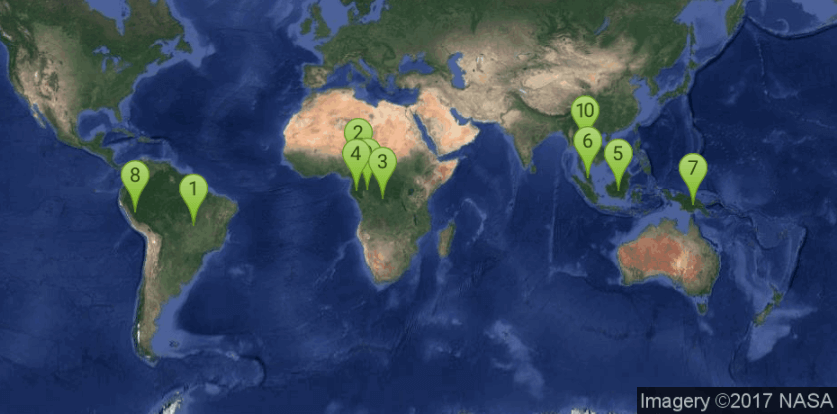
We identified 10 countries with large areas of high quality forest cover under threat from unsustainable timber and pulp production:
- Brazil
- Cameroon
- Democratic Republic of the Congo
- Gabon
- Indonesia
- Malaysia
- Papua New Guinea
- Peru
- Republic of the Congo
- Thailand
Company selection
With the list of priority countries selected, we identified key timber and pulp producers operating in these areas. We acquired an initial list of 383 companies provided by Bloomberg, refining the selection further by looking at those that specifically filed revenue from ‘forestry and logging’, ‘logging’ and ‘timber resources’. Other selection factors included location of operations, size of landbank and market capitalization.
SPOTT will initially score 24 timber and pulp companies, with a view to expanding this to 50 companies in future.
1. APRIL / RGE
2. Asia Pulp and Paper
3. Cikel Group</p
4. Interholco AG
5. Duratex S.A.
6. Groupe Blattner Elwyn
7. Groupe SEFAC
8. Groupo Jari
9. Klabin S/A
10. Oji Holdings
11. Olam International
12. Pallisco
13. Precious Woods
14. Rimbunan Hijau (RH Group)
15. Rougier SA
16. Samling Group
17. SLJ Global Tbk
18. Sodefor S.P.R.L.
19. Sumitomo Forestry
20. Suzano Papel e Celulose S.A
21. TA ANN Holdings Bhd
22. Toba Pulp Lestari
23. Vicwood Group
24. WTK Holdings Bhd
The first set of assessments for timber and pulp companies will be published in November 2017.
For more information and a full list of indicators and company details, please visit the assessment page for timber and pulp companies.
The Zoological Society of London (ZSL) runs conservation programmes in over 50 countries, including Indonesia, where we work to protect the Sumatran tiger (Panthera tigris sumatrae) through species monitoring, anti-poaching programmes, and engagement with local communities and industry. We recently invited members of the Roundtable on Sustainable Palm Oil (RSPO) to ZSL London Zoo’s Tiger Territory exhibit to find out more about our work in the field.
Tigers in decline
Tigers (Panthera tigris) – classified as Endangered by the IUCN Red List of Threatened Species – face a growing number of threats, from deforestation and habitat loss to poaching. Originally found across much of Asia, tigers now inhabit less than 6% of their historic range, with a 42% decline since 2006. At least three subspecies are now extinct, with tiger populations disappearing from Vietnam, Cambodia and Lao in as little as the last five years, where once thousands roamed.
Of the remaining subspecies, the Critically Endangered Sumatran tiger is among the most vulnerable to extinction. Sumatra has one of the highest levels of deforestation in Indonesia, leading to highly fragmented forest patches that cannot support healthy tiger populations. This also increases the chances of human-wildlife conflict and makes the forest more accessible to poachers.
The Indonesian province of South Sumatra is home to the Sembilang section of the Berbak-Sembilang National Park on the east coast and the Dangku conservation complex in its centre – some of the few remaining tiger habitats. However, less than 30 tigers are estimated to be living in the landscape, with no more than 400 individuals left in the wild.
Our work in Indonesia
ZSL first started working with the palm oil industry in 2001, after a company contacted ZSL for advice on how to manage populations of Sumatran tigers found in concession sites around their plantations. Since then, we have been working on tiger habitat conservation in Indonesia through a variety of initiatives.
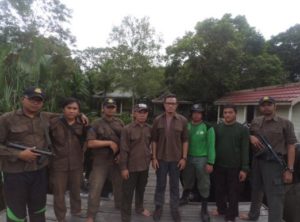
ZSL Indonesia’s Wildlife Crime Investigation Unit
According to a survey from TRAFFIC, the global wildlife trade monitoring network, poaching of tigers for the illegal wildlife trade is responsible for over 78% of Sumatran tiger deaths. ZSL has set up a Wildlife Crime Investigation Unit to tackle illegal wildlife trafficking. Together with our Wildlife Conflict and Response Teams, our teams are working to address key threats to tigers, including poaching, illegal trading and human-tiger conflicts.
Through a collaboration with the Indonesia Ministry of Environment and Forestry we have also set up Tiger Protection and Patrol Units to tackle tiger and prey poaching. The patrol teams make use of the SMART approach– developed by ZSL and other leading conservation organisations – to identify and map threats such as poaching or disease, and make patrols more effective.
KELOLA Sendang
In South Sumatra, we are working to increase connectivity between crucial tiger habitats, now too small to support viable populations on their own. Part of a much larger landscape level project, KELOLA Sendang aims to facilitate and support government, the private sector and local communities to pilot a sustainable landscape management partnership model, potentially replicable across other areas in Indonesia and beyond.
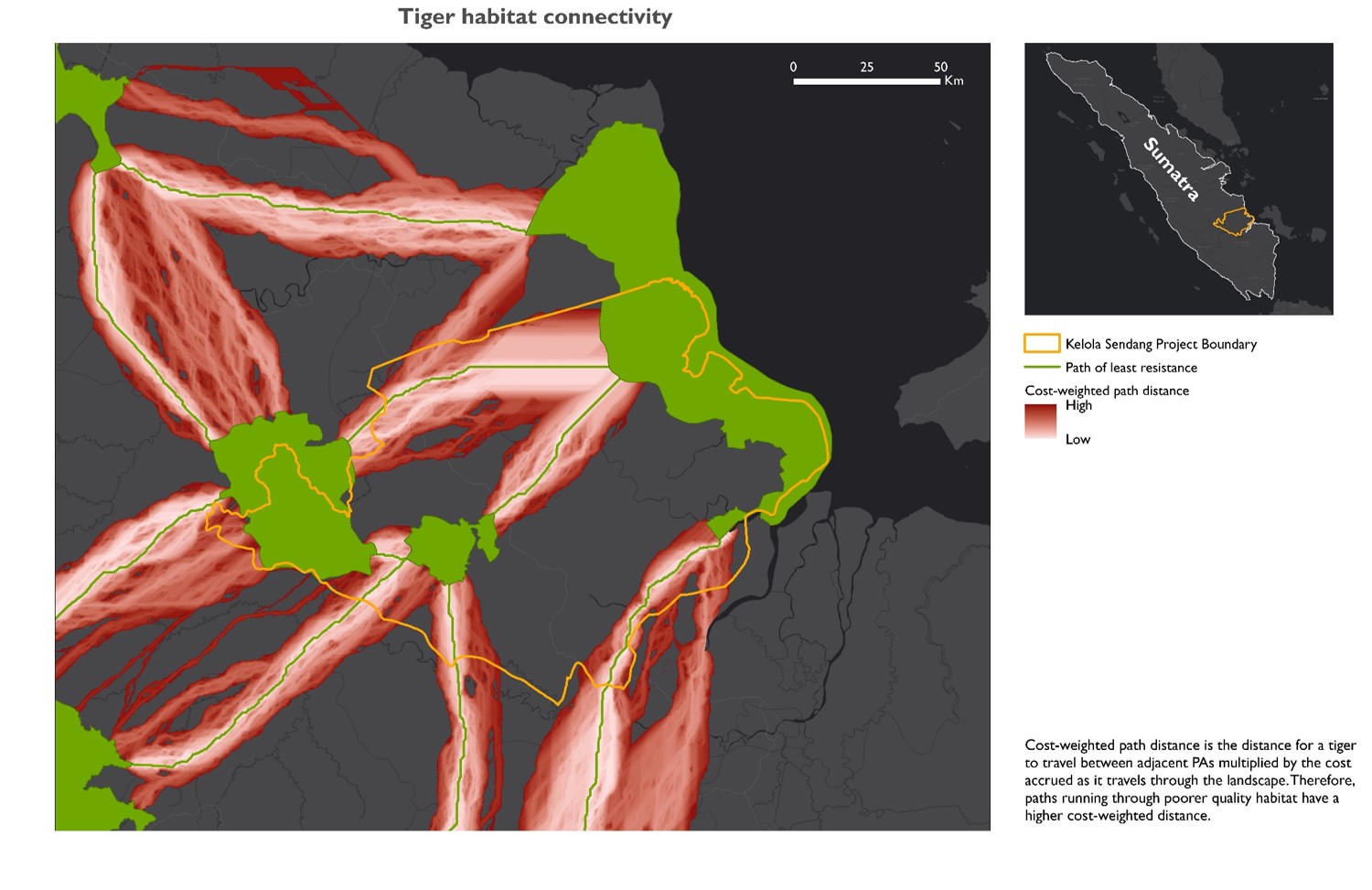
ZSL’s SPOTT initiative aims to assess key palm oil and timber and pulp producers, some of which operating in the Sembilang-Dangku landscape on their commitments to environmental and social best practice. Expansion of oil palm and pulpwood plantations was responsible for nearly two-thirds of the destruction of tiger habitat in Sumatra from 2009 to 2011, so engaging with these companies is crucial to ensure populations are protected.

Petra Meekers speaking at ZSL London Zoo
Following the RSPO European meeting in London, the SPOTT team recently invited delegates to an evening reception at our Tiger Territory exhibit at ZSL London Zoo. The event highlighted the importance of our conservation work with tigers and the palm oil industry, including a corporate perspective from Petra Meekers, Director of CSR and Sustainable Development for Musim Mas Group – a key palm oil producer assessed on SPOTT and operating in the KELOLA Sendang landscape. Petra reflected on the collaborative approach between ZSL and Musim Mas, emphasising the necessity of close consultation with multiple stakeholders.
On behalf of ZSL, we would like to thank our speakers and everyone who attended, and we look forward to further collaboration towards a sustainable industry – one that benefits people and assures a future for tigers and other animals.
As ZSL’s palm oil technical advisor, I attended this year’s Roundtable on Sustainable Palm Oil (RSPO) European meeting in London on 12-13 June 2017 to take part in a panel discussion on innovation and partnerships. The entire conference provided our team with opportunities to engage with companies on their forthcoming transparency assessments, but also to highlight the various reasons why ZSL and many other conservation organisations work with the palm oil industry.
Biodiversity at risk
 Worldwide biological diversity is in steep decline. Through joint analysis by WWF and ZSL, the Living Planet Report showed that vertebrate populations have plummeted by 58% from 1970-2012, and we are on track to lose two thirds by 2020.
This loss of critical biodiversity is a direct result of environmental pressure from unsustainable use of the world’s natural habitats. On a global level, human activities including deforestation, pollution, overfishing – compounded by the effects of climate change – are pushing species to the edge of existence.
Indonesia is home to some of the world’s most iconic and threatened species, and from 1990-2005, the country lost over 25% of its forest and woodland habitat.
As producer companies are responsible for managing large tracts of land, they have a critical role to play in managing this biodiversity decline. Encouragingly, national and subnational governments are showing an appetite for change, as demonstrated through a public-private people partnership, KELOLA Sendang.
KELOLA Sendang

KELOLA Sendang is a landscape project led by ZSL in the Sembilang-Dangku landscape in northeastern South Sumatra, Indonesia. The project seeks to facilitate and support government, the private sector and local communities to pilot a sustainable landscape management and partnership model, helping the Government of South Sumatra to achieve its Green Growth Vision, which looks to achieve inclusive economic growth, biodiversity conservation and forest protection and restoration. It also aims to reduce land-based greenhouse gas (GHG) emissions through preventing deforestation, peatland drainage and fires.
There are numerous competing pressures on the landscape including forest conversion, fires, illegal logging, growing human populations and peatland drainage. These drive environmental degradation, increase GHG emissions, and contribute to biodiversity loss. Given the multiple pressures on the landscape, a diverse range of partners is needed – one actor cannot work alone in this. The partners in this project are establishing biophysical baselines and monitoring for peat and lowland landscape management, ensuring broader participation of stakeholders in decision-making, and including community participation in land use and boundary mapping.
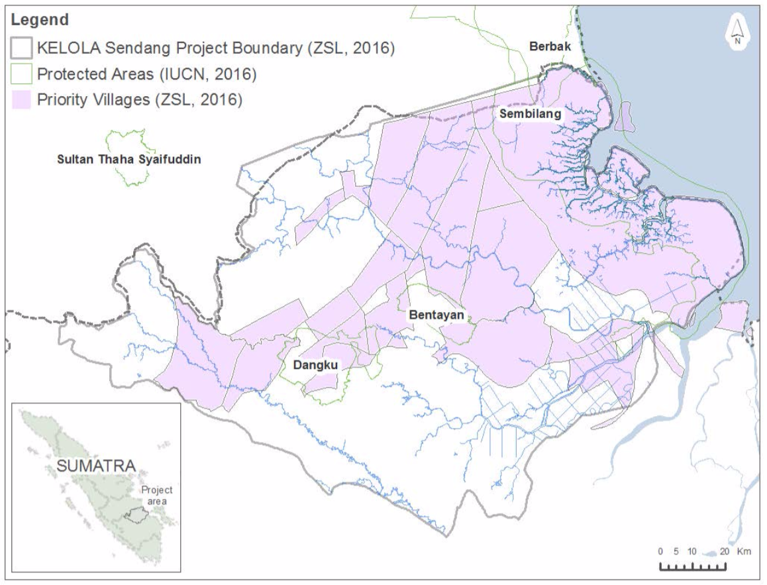
Another component of this project is using SPOTT to assess the environmental, social and governance (ESG) transparency of commodity producing companies – including those operating within the Sembilang-Dangku landscape. SPOTT ESG transparency assessments of timber, pulp and paper companies will be published in October, while our updated assessments of palm oil producers and traders – under a revised indicator framework – are due out at the end of this month.
The project is also working towards increasing connectivity between core habitats, creating corridors for tigers and other wildlife. ZSL first started working with the palm oil industry in 2001, advising companies on how to manage populations of Sumatran tigers found in their concession sites. On the evening of the close of the RSPO European Roundtable in London, we held an evening reception focusing on tiger habitat conservation following the RSPO European Roundtable at our Tiger Territory exhibit at ZSL London Zoo, to demonstrate our shared vision for a sustainable palm oil industry.
On behalf of ZSL, I would like to thank RSPO for hosting the 2017 European Roundtable in London, and I look forward to further engagement with companies, investors and other stakeholders in supporting transparency and moving towards more sustainable practices in the palm oil industry.
Banner image credit: James Anderson, World Resources Institute on Flickr CC BY-NC-SA 2.0